Showing posts with label culture. Show all posts

Saturday, 9 June 2018

Massive murals - Reykjavik


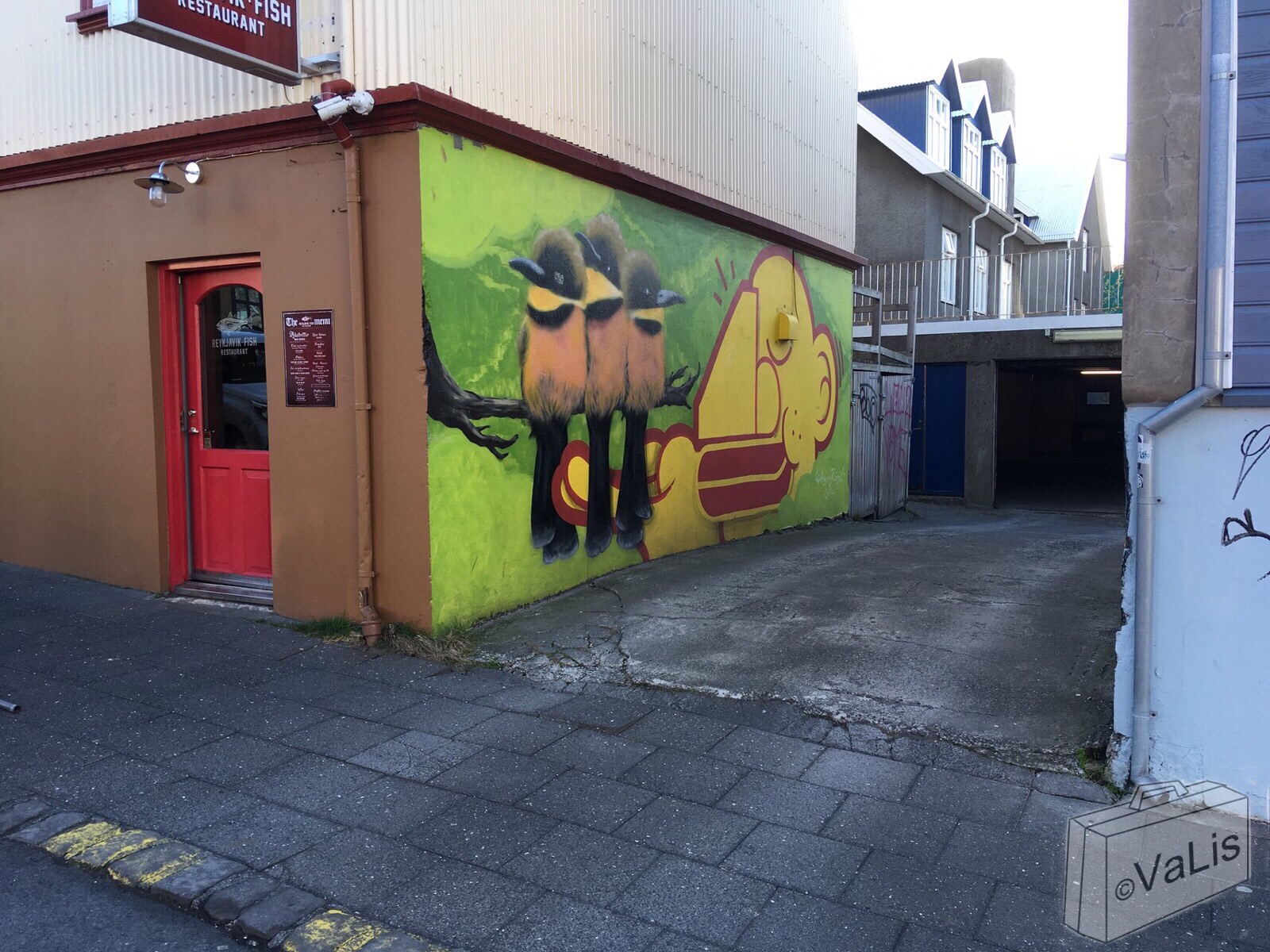
One of the first things that I noticed in Reykjavik were the murals. Just outside of our hostel were a few black and white pieces with a sixties feel to it on, what looked like, abandoned warehouses. (Yeah, we stayed in the best part of town...)
Then, as we walked into town, we saw so many more. Here are a few of my favourites. 

The first mural we spotted

Right around the corner from our hostel


The front of a bakery

At a back alley parking lot

The side of a restaurant 

At a construction site

This might’ve been my favourite 

Sunday, 12 March 2017

The red rock - Uluru

When planning a trip to any destination, there are usually a few places on the 'must-do' list. Uluru, or Ayers Rock, is on most Australia lists. And it was on ours, even though it is quite remote. But hey... it's iconic!

Walking around Uluru

We set out from Coober Pedy early morning, heading north. We had intended to drive to Erldunda (Some 400km). But Erldunda is not the most exiting place: it is a roadhouse at the Lasseter Highway turnoff, with a few emus in an enclosure. And since we there at noon, we decided to fill up and drive on.
That day we drove a distance of 750km, arriving at Yulara about half an hour before sunset. The only campsite in the vicinity of Uluru is at Yulara, and it's always busy. We were dishearted to hear they were fully booked that night.... 
Fortunately they do have an overflow field, where we could park for a night! A lot cheaper than the actual campground, but no electricity. Perfect!  

Flowers at Uluru's base

That first night we were too tired to get back in the car and actual go to Uluru, so we stayed at the village. Yulara is a village that is solely created to regulate tourism. It's just some hotels, a campsite, restaurants, shops and a petrol station in the middle of the desert, very artificial. But having said that, they have made a real effort to minimise scarring on its surroundings.
The efforts that stood out most for me: No building is higher than the surrounding sand dunes so they blend in from a distance (you don't actually see Yulara until you're there) and there is minimal lighting at night. In the middle of the village is the highest dune, planet with local species, from where you can stare at Uluru some 20km away. The lack of lighting can be annoying when you have to walk to an amenity block in the dark, but certainly ensures that you can enjoy some serious star gazing. 

Sun on stone

The next day we got up (too) late, and after breakfast, we drove to the National Park. We started at the visitor information centre, to learn a bit about the indigenous people's background, the Dreamtime and history of the area. A highly recommended visit.
By the time we were ready for a walk, it was almost eleven.... not a sensible time for a walk in the desert. But since it was winter, we decided to go ahead.

Uluru's surface has many more holes than I expected

You are still allowed to climb Uluru, but are requested not to, something I personally think you ought to respect. So we did the 10km base walk around it instead. An easy walk on level surface, with no shade. At all. I do not want to know what that's like in summer!
The base walk circles Uluru, so you see its different sides, and we were surprise how varied its surface is.

Grey-headed honeyeater at Mititjulu waterhole

Uluru is seen as a visible reminder of Dreamtime tales, and as such, some parts are not to be photographed. Most of these areas have informative signs, telling you about the remnants of a particular tale visible on the surface.
One of my favourite areas was the Mutitjuli waterhole at the south side. We sat there for a good while, and watched the wildlife. Brightly coloured blue and red dragonflies, brown-red butterflies and the inquisitive grey-headed honeyeater.
It was a very tranquil place. We were amazed when we saw a video that was shot 6months later, that showed massive waterfalls at this exact spot!

Uluru Base walk

That evening we returned to the park to watch the sun set over Uluru. This is what is features in all the brochures! It was very busy. Rows and rows of campervans. We had one of the last parking spots, and enjoyed nibbles and a drink while we waited comfortably, sat in the back of our van. It was a pretty sunset, though it didn't feel like all it's made up to be.
Until I saw my photos. They make it look amazing!
On our way back we drove under the light of the moon. It was full a moon that evening, and it must've been close, because it looked very big.
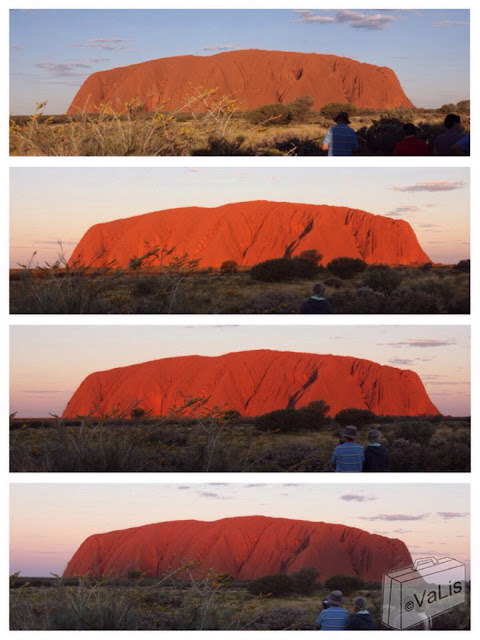
Classic Uluru sunset

Friday, 28 October 2016

There and back again - Hobbiton


  • Now who's a good nerd?
  • Me! Me!
So no way around it, is there?
One MUST go to Hobbiton....
And so we did.

First look at Hobbiton

When we decided to visit New Zealand, the main draw for us were its impressive and diverse landscapes. That happen to feature prominently in the Lord of the Rings movies (and many, many others).

One of many hobbit holes

During our time here we will visit several of these landscapes, but we also went to Hobbiton. This is no landscape, but a fictional village: the actual movie set of the Hobbit village. Kept and maintained as it was during filming. Of course the owners are making a fortune doing tours of it, and it is pretty touristy, but also so much fun!

The Party Tree and Sam's house

We booked our tour online, and waited at the Shire's Rest (I know!) for our guide. Everyone gets into a big coach, and we drive onto the farm where the actual set is. During that short drive they show a short video telling a bit about the logistics of filming, and our driver pointed a few things out in the landscape. And then we are there, out of the coach we walked into the village through Gandalfs Cutting.

Bag End

It really is nice, seeing the whole village appear around you, even when it is quite full of tourists. The little hobbit holes all around, all the detail that went into making it look like a live village, and those particular features (the party tree, Bag End, the Green Dragon Inn, etc.) that look so familiar due to the movies. Needless to say we loved it. 

Green Dragon, bridge and the Mill

And they really do make an effort to keep it top notch. All the flowers and gardens are meticulously kept, smoke comes out of the chimneys and they re-leaf (new verb!) the one artificial tree every few years. 
After a walk around the little lanes of Hobbiton, shooting all the obligatory photos, marvelling at the different holes, and learning new trivia facts from our guide, we headed down to the Green Dragon for a drink. 

Inside the Green Dragon

During filming this was just a façade (Hobbiton was an exterior set), but for the tourist tours they built the inside of the Green Dragon as well. The inn is pretty much identical to the one in the movies, and again, it's well done. We sat down to enjoy our beers (ginger beer and stout) in front of the fire. Before long it was time to leave the Shire, and go back to the real world.

Back to the real world

Saturday, 30 April 2016

Casa particular - Trinidad, Cuba

A fortnight into our trip on Cuba we arrived at Trinidad.  A city known for its 19th century architecture. We arrived in the dark, but since we were told that every other house in Trinidad was a casa particular (the Cuban version of a B&B)  we weren't too worried about finding a place to sleep.   We arrived after sunset, but luckily the bus station is in the centre of town.
We walked to the first casa and they were fully booked. So was the second. And third. Then we decided to walk to what we guessed was the main street and started ringing the bell with every house that had a sign.  Conveniently in Cuba all registered casas must have a sign. A few didn't even answer the door and the others were full. And it started to rain. Time for a change of plans.
Living room
We walked into a quieter street, looking for casa signs. First one: fully booked again, but could they recommend a place? Not really.... At that point a neighbour passed by, heard our question, and came to our rescue. He rang the bell at a door with a somewhat weathered casa sign, asked the old man that opened if he had room, and he did! We ended up with Miguel: in an amazing house, with a lovely courtyard and that had a very colonial era atmosphere.  Truely a hidden gem. (For more photos)
It turned out that everything during our stay in Cuba (November '15) was overbooked: so may people wanted to visit before the country opened up in 2016.

Breakfast spot
Miguel works as a physician in the mornings, but is a lovely host after that. He speaks both French and English and loves a chat, but doesn't bother you. Each morning a young couple arrives at the casa; she makes breakfasts and does the housekeeping, he takes care of the house, plants and animals; a large portion of the courtyard is dedicated to bird cages.  Imagine having your breakfast in a luscious green courtyard, with the chatter of birds. And those funny curly tailed lizards!

Curly tailed lizards
The house itself: very heigh ceilings, pastel colours, decorative tiles, shady veranda, and the furniture and bathroom came right out of the 1930s! We really enjoyed our relaxing stay

Friday, 19 February 2016

Traditional temple stay - Koya San

Japans Kii peninsula has long been a mystic area, and therefor is littered with sacred sites. Koya San is one of them. This is where the tomb of Kobo Dashi: the founder of the Shingon school of Buddhism, is. Koya San is a mountain, or rather a plateau, where you will find more temples than houses. The place to spend the night here, is of course in one of these temples. So we did.

Cable car up the mountain 

We took a train from Osaka to the base of the mountain. Once there,  a steep ride with the cable car brings you to the top.  We took bus for the final leg to 'our temple': Muryoko-in.  Once registered, we got our slippers, and a monk showed us to our room.
This was a simple Japanese room: separated by paper walls, futons to sleep on, a few cushions to sit on and yukata (casual kimono) to wear.

Our room, with red slippers in the hallway

After our check in we walked a bit through the town, and then back to our room for dinner. This was a traditional Buddhist dinner: vegetarian and without strong smelling ingredients like garlic or onions. With a quiet knock on the door the monk announced his arrival, and then entered the room with neatly stacked tray tables. Like all food in Japan, this was beautifully displayed.  And tasty too!

Dinner is served

After dinner we took a quick dip in the traditional (shared) Ofuro, layed out our futons and were asleep by 10 pm. The next morning our alarm was set to 5 am! 
We had been invited to join the Gotomaki fire ritual, and being in a temple, we really wanted to. With some other guests, we sat in the back row of the ceremonial room.  The ceremony took about 80 minutes and we both were really glad we were there.  What was it like?

The room was very dimly lit, and one monk was continuously chanting. The other monks joined him intermittently. A fire burned, being fed by one of the younger monks. The whole esoteric atmosphere kind of drew us in. At the end we were invited to participate by adding to the fire and joining the final chant. We didn't take photos but just enjoyed it.

Koya San street view

During our visit a Swiss monk lived in the temple, and he invited us for a little chat afterwards. While drinking tea with some sweets he explained the ritual, the different elements of the Shingon Buddhism and temple live in general. This really added that bit extra to our temple stay. And after our chat.... it was time for breakfast, which we had in a communal room with the other guests.

One of our breakfast dishes

Saturday, 12 December 2015

Cuban colours

I just returned from Cuba: a nation in transition. I'll leave my deeper thoughts for a next post, but right now I just want to share a few photos that are in my mind typical for Cuba.  The colours of her streets.

Typical art deco building in Havana's Vedado

In Havana you can easily distinguish in which area you are, by looking in at the buildings.  Vedado was built in the first halve of the 20th century: Think roaring twenties, art deco in pastel.

Wandering in the streets of Havana Vieja

Havana Vieja is, at the name says, the old part of the city. Though nowadays you can argue about the 'old':  This area is tourist town, and heavily renovated. But very respectfully renovated I must add.

Walking in Trinidad

Trinidad was built during the sugar boom in the 19th century. Colonial style buildings, super high ceilings, wrought iron lattices, and cobbled streets.

Camaguey

Camagüey is one of the very few cities in Cuba that isn't built in a grid like street pattern. Because it was raided several times by pirates it was actually designed as a maze.


Camaguey


Tuesday, 23 June 2015

Pandas in the mist... - Chengdu

Of course, when you're travelling through China for some time, you HAVE to see its national symbol: panda bears!
China is very proud of them, and very protective. In a Chinese manner. So while their natural habitat keeps diminishing, serious money goes into breeding programs. One of the main, and very accessible, breeding facilities is in Chengdu. So that is where we went. And Chengdu in November turned out to be extra wet and foggy.

Panda's coming out into the mist

The panda centre is a little out of town. You can take a local bus, or book a tour with the place where you are staying. We stayed at a lovely hostel, and booked our transport through them. After paying the entrance fee you can wander through the park. The park looked much better, and more animal friendly, than we expected.
Though, as you can see from the photos, it was sometimes even hard to see the pandas in the mist!

One of the enclosures for the youngsters, food and exercise

Like in the wild, the pandas spend most of their time eating. Since pandas eat bamboo, one of the least nutritious foods one can imagine (for carnivores!), getting enough food in, is their main concern. Maybe their only concern, since pandas are not known for their breeding capacity.... That's where the breeding centers come into focus.

Always eating!

Because of the low calory intake, the panda is a very inactive animal and non social animal. It all requires just too much energy! And to make it even more of a challange: a female panda is fertil for about 23-36 hours per YEAR...
If a panda manages to get pregnant against all odds (or by AI), she usually gives birth to twins. But since a panda does not have enough milk for both, she only takes care of the stronger twin. To let it survive, the weaker cub is separated from the mother, and raised in a nursery. We were not allowed to visit the nursery, but could quietly walk passed the 'visiting window'.

About 2 week old cub

After about two years the cubs spend a few years in 'play groups' of 4-5 individuals, until they come to an age that they do no langer want to be sociable. The older animals al live solitary, as is their nature. But until then, they are super cute to watch!

You should relax while eating

Wednesday, 29 April 2015

Korean cultural snippets - South of the DMZ

It's been a while since I posted anything. The main reason is that I've been too busy working, but I have made a quick trip to Korea as well! And even though we have spent a fortnight there, which isn't really short I you think about it objectively, it did feel like a quick trip!

Memorial Park in Munsan
So this post is about my first impressions of Korea. It felt to me like a mixture of Chinese and Japanese. Which is probably true. Korea has long been a satelite state of the Chinese imperium, and later has been occupied by Japan. So the noise definitely sounded Chinese to me, but the way things are done in a set manner, the emphasis on the 'correct way' of doning anything, reminded me very much of Japan.

View over Munsan (to the north)
And the fact that Korea has been in a permanent state of war since the 1950's does show. The people themselfs do not seem very concerned with it. But for us tourists, it was quite visible in places.
We visited our friend, who lives in the border town Munsan (1 hour north of Seoul), and we decided to go on a morning walk in the surrounding country side. The path started right behind the memorial park. And then passed trenches and foxholes, not used at that moment, but very well maintained. But it was quite busy that morning with other hikers and no one but us seemed to notice the millitary appearance.

Walking past trenches
Now.... the correct manner to go hiking in Korea. Firstly, you need to wear the proper hiking gear. That means: hiking trousers in a bright colour, with black patches on the inside of you legs. A matching long sleeved, light wear jacket. Both in this season's colour. The seasonal colours this spring were orange or pink, we were told that last autumn they were burgundy and mustard.
Under your jacket you wear a long sleeved shirt, the woman wear a large sunshade and the man a cap, and every one wears trainers with neon laces. Of course you carry a backpack. Optional accesoires are walking poles, bandana and gloves.

Typical Korean hiker (from SFA)


Sunday, 15 March 2015

Spirit of days past - Baga Gazriin Chuluu

One of the first stops we made on our little tour thru the Gobi was near the rock formations of Baga Gazriin Chuluu.  Legend says that this is where Ghengis Khan grazed his horse, but then again, Ghengis must have grazed his horses a lot...

Roads in the Gobi

Anyway, even though for us tourists the 'roads' in the desert were not always obvious, it was obvious that many people travelled to this spot by the number of ovoos. (More info in this post)
Baga Gazriin Chuluu is also where the Delgeriin Choiriin Khiid monastry used to be. Before the Russian occupation of Mongolia, most of Mongolia held Buddhism as it's religion: in a land of a nomadic people and thus mostly temporary buildings, there were over 3000 temples in the early 1930's.

Looking down at our minivan

That all changed during the Purge, and by the late 1940 only one temple was left. The number of monks had dropped in two decades from more than 100.000 to a mere 100. 
This is the reason that Delgeriin Choiriin Khiid was abandoned and had fallen into ruin.

The abandoned grounds

When you walk onto the grounds of Delgeriin Choiriin Khiid the feeling of sadness is overwhelming. There are still many (small) trees there, a rare sight in the desert. Remnants of a past life.
It feels like a sacred site. A place to ponder.

A place to ponder

An occasional scarf is tied around a tree, to emphasize the sacred purpose of this site. When I googled, I found out that since our visit in 2009, reconstruction has begon of the temple, like many other Buddhist sites. For now a temporary temple is set up in a ger in the plain in front of the original site. Visitors can stay overnight in surrounding gers.

Friday, 27 February 2015

Something fishy - Tsukiji Market Tokyo

When you google at 'top things to do in Tokyo' you can almost be sure that Tsukiji fish market will pop up, most notably the tuna auction.
Being a food market lover myself, I really wanted to go there. But... the tuna auction starts at 6 am. And only a limited number of tourists are allowed to attend, so you have to queue at around 4 am. There is no public transport at that time of night (oddly enough Tokyo's public transport stops around midnight?!) so you have to either walk there, take a cab, or wait over a few drinks at one of the nearby pubs.  We opted out of attending the tuna auction, bad tourists...I know!

One of the small stalls

At around 8 am the rest of the inner market opens up to visitors, so there we were. Surrounded by tour groups, we entered the public space.

And now I hear you wondering...How was it??? First impression: way more tourists  than expected, and at the same time less of a tourist trap than expected.  First and foremost, this is a place where people work, no signs which way to go or defined routes. This also means that you have to be carefull not to be overrun by one of the funny, and very fast, carts. Even  though there is hardly any room to walk in between the stalls, the carts race past!

Tuna waiting for a buyer

The fish and seafood they sell is simply amazingly fresh and varies from extraordinary to bizar.  And it is a lot.  The sheer number of sea creatures on sale was mindblowing. It really made us wonder how much longer it takes to empty the oceans.

Super size mollusc

Of course there was an abundance of tuna. Al tuna arrives deeply frozen. Did you know that those beautifull slices of sashimi are precut in to blocks, while frozen, with a industrial band saw? I didn't!

I saw the biggest mussles I ever saw: at least 3 times the size of my hands. Crates of roe, alien crustaceans, unknown molluscs, vibrant octopi and fish in alls size and sorts inlcuding some wiggly, still alive, skewered fish.


Sawing sashimi blocks

The traditional thing to do after visiting the Tsukiji Market is to eat fresh sushi. Most people try to do that in the inner market, but the outer market makes a good alternative if you want somwhere (slightly) less busy.  We didn't do that either... we were such lousy tourists, I know! But the massacre we had just witnessed satiated or need for animal protein.

Vibrant octopi