Showing posts with label Australia. Show all posts

Saturday, 21 October 2017

Valley of the Wind Walk - Kata Tjuta

When visiting the Australian Outback, the Red Centre, everyone goes to Uluru. As did we.
But entry to the National Park of Uluru encompasses more than just Uluru. The other major site is Kata Tjuta, or the Olgas, and since entry is always for 3 consecutive days, we went there as well. 

Driving towards the Olgas

Kata Tjuta has a few different trails, but we opted for the most well known: the Valley of the winds trail. It starts and ends with a short trail to Karu lookout. From this lookout you have a view over the valley, but this is also a checkpoint. If the temperature is over 36'C the trail closes. During summer this happens a lot. 
Since we did this hike in winter, we had no such limitations. 

Trail head

The red rocks at Kata Tjuta are basically the same as Uluru, though their angle is different. The monolith that forms Uluru is set vertically into the ground, while the rock at Kata Tjuta is set horizontally, causing a different erosion pattern. Form a distance they resemble marbles, morphing in to beehives as you come closer and impressive rock as you wander amongst it.

Red skin

We decided to walk counter clockwise, starting with walk in between the rocks. We followed the little triangles on the signpost, until we lost them...  after a few km the triangles were painted on the rock, and not always very visibly so.
The last bit toward the Karingana lookout went up pretty steeply, clambering on all fours for a bit. and then suddenly we were there. What a view!

Karingana lookout: the highest point of the walk

It's amazing how suddenly you cut a corner, walk over a ridge and you see this amazing view over a valley that been completely hidden thus far. Maybe it should have been named the 'Hidden valley walk'.
But  while admiring the view, we understood how aptly named this 'Valley of the Wind' walk is. At Karingana lookout it was a lot colder than at the rest of the track, the wind was ON.

Valley of the wind

When we arrived at the floor of the valley the landscape had changed dramatically.
The red rock had given away to green plants with a purple haze of dessert flowers in bloom. The temperature had increased, and I really don't want to imagine what it would be like doing this hike mid summer when it was this hot mid winter!

Myriad of flowers

After an hour or so we arrived at the only watering point in the valley. That had a dripping tap. Much to the liking of a few local zebra finches.
We sat watching them for 20 minutes or so, amazed that the cute little bird are so common in this part of the world. I
 

Zebra finch at a watering point

We the walked on for the last little bit of the track, back to the Karu lookout. It was a lovely walk, and a lot more diverse than the obligatory Uluru circle walk.

Driving back to our campsite we had a few anxious moments though... We had gotten up early that morning to watch the sunrise over Uluru, and then drove directly to Kata Tjuta. And only when driving back realised that we're running on empty while the sun was setting. The closest petrol station was 50km away, and after sunset the park is of limits, so a very small chance of fellow drivers fining you. we turned off the aircon, folded in both mirrors, drove slowly and thankfully made it back on the last few drops of petrol. 

Looking back


Sunday, 12 March 2017

The red rock - Uluru

When planning a trip to any destination, there are usually a few places on the 'must-do' list. Uluru, or Ayers Rock, is on most Australia lists. And it was on ours, even though it is quite remote. But hey... it's iconic!

Walking around Uluru

We set out from Coober Pedy early morning, heading north. We had intended to drive to Erldunda (Some 400km). But Erldunda is not the most exiting place: it is a roadhouse at the Lasseter Highway turnoff, with a few emus in an enclosure. And since we there at noon, we decided to fill up and drive on.
That day we drove a distance of 750km, arriving at Yulara about half an hour before sunset. The only campsite in the vicinity of Uluru is at Yulara, and it's always busy. We were dishearted to hear they were fully booked that night.... 
Fortunately they do have an overflow field, where we could park for a night! A lot cheaper than the actual campground, but no electricity. Perfect!  

Flowers at Uluru's base

That first night we were too tired to get back in the car and actual go to Uluru, so we stayed at the village. Yulara is a village that is solely created to regulate tourism. It's just some hotels, a campsite, restaurants, shops and a petrol station in the middle of the desert, very artificial. But having said that, they have made a real effort to minimise scarring on its surroundings.
The efforts that stood out most for me: No building is higher than the surrounding sand dunes so they blend in from a distance (you don't actually see Yulara until you're there) and there is minimal lighting at night. In the middle of the village is the highest dune, planet with local species, from where you can stare at Uluru some 20km away. The lack of lighting can be annoying when you have to walk to an amenity block in the dark, but certainly ensures that you can enjoy some serious star gazing. 

Sun on stone

The next day we got up (too) late, and after breakfast, we drove to the National Park. We started at the visitor information centre, to learn a bit about the indigenous people's background, the Dreamtime and history of the area. A highly recommended visit.
By the time we were ready for a walk, it was almost eleven.... not a sensible time for a walk in the desert. But since it was winter, we decided to go ahead.

Uluru's surface has many more holes than I expected

You are still allowed to climb Uluru, but are requested not to, something I personally think you ought to respect. So we did the 10km base walk around it instead. An easy walk on level surface, with no shade. At all. I do not want to know what that's like in summer!
The base walk circles Uluru, so you see its different sides, and we were surprise how varied its surface is.

Grey-headed honeyeater at Mititjulu waterhole

Uluru is seen as a visible reminder of Dreamtime tales, and as such, some parts are not to be photographed. Most of these areas have informative signs, telling you about the remnants of a particular tale visible on the surface.
One of my favourite areas was the Mutitjuli waterhole at the south side. We sat there for a good while, and watched the wildlife. Brightly coloured blue and red dragonflies, brown-red butterflies and the inquisitive grey-headed honeyeater.
It was a very tranquil place. We were amazed when we saw a video that was shot 6months later, that showed massive waterfalls at this exact spot!

Uluru Base walk

That evening we returned to the park to watch the sun set over Uluru. This is what is features in all the brochures! It was very busy. Rows and rows of campervans. We had one of the last parking spots, and enjoyed nibbles and a drink while we waited comfortably, sat in the back of our van. It was a pretty sunset, though it didn't feel like all it's made up to be.
Until I saw my photos. They make it look amazing!
On our way back we drove under the light of the moon. It was full a moon that evening, and it must've been close, because it looked very big.

Classic Uluru sunset

Thursday, 6 October 2016

Wildlife or not - Monkey Mia

At Australia's west coast, we went to Shark Bay. This area is known for its superb and approachable wild life. Monkey Mia, at the north of the peninsula, is famous for the dolphin encounters. 
On our way there, we stopped to look at ancient life forms, called stromatolites. These are what kickstarted life on Earth as we know it. And they still exist! To the untrained eye (like mine) they look just like rocks, but these are actually organisms, consisting of several strands of clustered bacteria. I think it's pretty cool to have seen them.


Stromatolites

We then went on to Monkey Mia, basically the name of the resort. The Monkey Mia Reserve is a little area, surrounding the resort. You can't acces the resort without entering the reserve, thus you'll always have to pay the extra acces fee.
We parked our campervan at the campground, went to the beach. On the beach were several pelicans, seemingly undisturbed by the humans around them. We had fun watching them (as you can read in this previous post). Just off the beach, we saw several dolphins foraging in the water, pretty amazing.

Pelican ruffling its feathers

The next morning we went to the beach for the 'Dolphin Experience'. This is what everyone comes for. Wild dolphins being hand fed by people. According to all the brochures is has been the natural behaviour of the dolphins to visit this spot for years. Now the reason the dolphins started coming to this spot was actually human behaviour: fisherman throwing them leftover catch. I wouldn't classify that at 'naturally showed up', but to each his own. The Department of Parks & Wildlife decided to regulate dolphin encounters through the Dolphin Experience.
I'm still not sure whether I like it. 

Dolphin waiting for a handout

Based on the information DoPW give, they try to do it in a way that is least disruptive to natural behaviour do the dolphins. They feed only 5 selected individuals, the other dolphins never get handouts to minimise contact. They give no more than 10% of their daily intake, forcing them to continue hunting. The interaction is 20 minutes so mothers go back to calves, all spectators must stay out of the water, no touching, etc.
But feeding wild animals, fully capable of fending for themselves... 

Pelican trying to snatch a handout

But then again, before DoPW stepped in, the human-dolphin interaction went wild, calves starved due to neglect (a death rate as high as 90%!) and several dolphins attacks occurred. At least it is regulated now. And on the day we went, it took a full 2 hours for the first dolphin to show up. So they don't seem too dependent on the handouts. The  funniest thing at the whole experience though was watching the pelican trying to wiggle himself in between dolphin and fish bucket. He got more attention then any dolphin I saw. 

Shell Beach

After lazing another day at the beach, and a boat tour (which wasn't that good, but we did to see dugongs!) it was time to move on. Driving off the peninsula we made a final stop at Shell Beach.
In the sunshine it looked as bright white as any tropical beach. But a closer look reveals it isn't sand, but millions and trillions of tiny cockles. These live in the super saline water, where most life doesn't survive. (A sand bank allows the tide to go in, but not to go out, the water vaporises, and the remaining water becomes ever salter.) As the cockles die, they wash up, and form this beach.

Shell Beach 


Sunday, 2 October 2016

Look but don't touch - Rottnest Island

And that's pretty hard sometimes! Rottnest Island is full of wildlife, and most of the animals have no real fear of humans. Specially the local marsupials display an unsettling lack of fear. These cute quokka's make it really hard to not to just pick 'em up and cuddle.
Even though the first Dutchman didn't feel the same, they thought they found an island teeming with enormous rats, hence the name: Rottnest.

Quokka

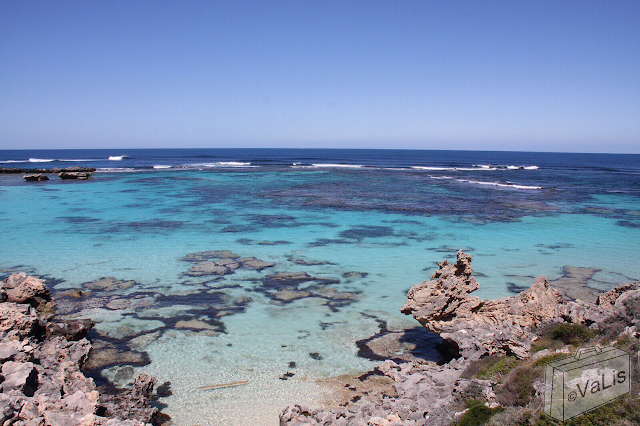
But it's not just the wildlife that makes Rottnest a really good daytrip, the views are spectacular too. The turquoise and coral blue waters are like nothing we have in Europe. While cycling round the island (a full circuit is about 30km), you go from one spectacular bay to the next. We headed out via the south shore.

Looking towards Perth

Snorkelling is another way to enjoy the landscape, and several bays have special snorkel routes laid out, including under water markers. Very cool idea. But we felt that even though it was a lovely sunny day, the water was just a bit too cold for snorkelling.

One of the amazing bays

Like the rest of Australia, there are many, many birds at Rottsnest. Here, you mostly see ravens, and they aren't shy either! But fortunately they're not  aggressive at all. They're quite likeable actually.

Australian Raven

Another bird that you encounter quite often in south west Australia is a little brown pigeon: the Laughing Dove. We saw them on Rottnest too. It's not endemic to Australia, but was introduced from sub-sahara Africa in the late 1890s and has seemed to settle in nicely. 


Laughing dove

We decided to have lunch at the western end of the island, Cape Vlamingh. Like many tourists do. But it is a nice spot for lunch.
This is where the Indian Ocean really starts, and there's quite a surf. In season you can spot nesting ospreys (we didn't) and passing humpbacks (we did). There's also a nice boardwalk, from which you can reall appreciate the waves and little coves. Under and next to this boardwalk were dozens of King's Skinks. We had seen a few during our ride, but not nearly as many as here.

Kings Skink

Before heading back to the ferry via the island's northern shore, we stopped at Cathedral Rocks to watch the seals. It turns out we did see a few seals from Cape Vlamingh, but we weren't sure at the time. It turns out they were flipper sailing, which means you just see black things bobbing in the waves. Especially from a distance there's no telling these are animals. But watching them from Cathedral Rocks Lookout, where you can watch them from a lot closer, clarified that.

New Zealand fur seals

Wednesday, 21 September 2016

Memorable marine encounters - Coral Bay

The small coastal towns at the Ningaloo are all geared towards water related activities. Think surfing, whale watching in season, and whalesharks! (Which is March to July)
Another must-do is diving or snorkelling. With the fringing reef so close to the coast it's a waste not to. Of course we've done some in Exmouth, but we also went a little further south to tiny Coral Bay. (2 campsites, 1 hotel and 8 shops, of which 7 tourism related.) 
But Coral Bay has something extra special: a resident manta ray population! To be more exact, there are a row resident mantas, and many seasonal and visiting ones. But it is one of the few places where you are almost guaranteed to see them year round. A chance not to miss.

Exploring Ashos Gap

There are many manta ray snorkel tours on offer, but since there's just one dive shop in Coral Bay, our choice was an easy one. A full day tour, with a dive in the morning and afternoon, and a manta interaction snorkel in between. If the mantas felt like it. Because the previous week they hadn't shown up for five consecutive days... But, if you don't try, you're sure not to see them. 
Later that afternoon, the dive shop owner told us our tour might not happen, since the other couple that had signed up, had cancelled. And they had a 4 person minimum. After a few phonecalls that evening it was certain: no tour tomorrow. So we spent an extra lazy day at Coral Bay and went one day later: on a fully booked tour. 

After the usual morning fitting sessions (who doesn't love a cold damp wetsuit in the morning?) that go with dive tours, we were ready to go. And can I just add that I simply love Australian sizing? I easily fit a S, sometimes even XS suit, always nice when (un)dressing in front of complete strangers. 


Blue spotted stingray 

On board were 10 divers divided in 2 groups. We were happy to be in the 'experienced' group, which made for lovely relaxed dives. We all had about the same pace and mindset. Keeping an eye out for each other, but wandering off a bit it you saw something interesting. As opposed to the 'less experienced'. When we saw them, the six of 'em were huddled in a tight knit, condensed shoal following the leader.

The first dive was around a clusters of coral bommies not far of shore. We saw loads of tiny fish, some bigger ones like potato cod, little cleaning fish doing their job, a few blue spotted stingrays hiding underneath the corals, nudibranches, sea worms, a moray eel, clown fish, and loads more.
It's pretty cool to see how every coral and anemone has its own species of related fish. Two coals right next to each other, but slightly different, both have tiny fish on them, but slightly different. 
The underwater landscape was really nice too.

First look at a wild manta ever

When we surfaced after a shallow 55minutes dive, it was time to head to Batemans Bay. In search of mantas. 
On our way there we got some instructions on what to do and what not. In the mean time a spotter plane was on the lookout for mantas to optimise our chances of seeing one.
We were divided into two groups, and instructed to sit on the rear of the boat, on the platforms. Fins and mask on and snorkel in. The boat would drop us in the manta's expected path. At the crew's 'go, go go' we slid in the water, moments before we saw th manta underneath us! 

How utterly, extremely cool was that! 
Just a few meters below us was the his magnificent creature, gently flapping its wings. They really do fly. 

Showing its belly just before flying away

We swam with it, until some of our group got slower. That was when our guide gave the cue to stop swimming. Group two was then dropped, after which we were picked up again. As soon as the other group stopped swimming we were again dropped in. The second time in, the manta swam sideways for a bit. 
Another boat in the vicinity had had no luck yet with finding a manta, so our skipper decided that we'd pull back for a bit to give them a go. We looked on, and to be honest, our tour looked far more professional in getting everyone in and out of the water. And it was apparent that we had some stronger swimmers on board. Because it does take some effort to keep up with a feeding manta! 

We then did our third and final run. Most of us stopped swimming when directed, but one of our group continued... Rodie stealthily joined group 2 for an extra long manta swim! Afterwards we had lunch aboard, and went to the next diving spot. During that trip we saw even more wildlife: Dolphins, several turtles surfacing to breathe, stingrays, and even a humpback with calf! 

Giant cuttlefish

After that superb manta swin, we really didn't care that much about our second dive, but happily went in. What a surprise was that second site! Ashos Gap are two interconnected bommies, with a cleaning station at it. Basically it is one massive coral garden. We stayed under for an hour, and swam above coral that enitire time.

Some really good marine life too. A lovely green turtle (I never get tired of those!), a distant grey reef shark, some barracudas, giant clams, and a really big giant cuttlefish. This one was about 30cm, and prettily changing colours as we stayed with it for a bit. 
The number of small fish was incredible, and the coral itself was more diverse than at the first spot. Really. Opal was that you could actually see some of the coral 'breathe'.
Yep, that was a pretty amazing day! 

Green turtle

Tuesday, 20 September 2016

Pelican party - Monkey Mia

We came to Monkey Mia to watch dolphins, who are known to visit the beach every day. After we parked the campervans, we decided to enjoy a beer on the beach, while staring at the sea.

I can see you...

And, joining us on the beach were a few lazy pelicans. Now, since I really like Pelicans, I thought I'd treat you to some random pics of 'em. 
 
Heeeeeeey!

And I really feel that they're not the most intelligent animals around, but correct me if I'm wrong in that one. 

Does this make me look smart?

But they are very amusing to look a at. One even did a little random dance, just for us I think.

Doing a random little dance

We had fun watching them, hope you do too!

Beak stretching 

Saturday, 17 September 2016

Turquoise drift - Exmouth

After our Broome adventures, we visited inland Karijini NP, which was stunning. Then we headed back to the blue waters. Or should I say turquoise waters? It was time to finally visit the Ningaloo Reef!

Turquoise Bay beach

The Ningaloo reef sits on Australia's west coast, and is far less visited than the Great Barrier Reef. But supposedly at least as beautiful. This is one of the main reason we really wanted to see Ozzie's west coast. 
One of the really good things about the Ningaloo is, that it is a fringing reef, so it really close to the coast. (The GBR is always at least a boat ride away. ) We decided to start in Exmouth, on its northern end.

Turquoise Bay Area corals just under water

When we arrived in Exmouth, we expected a bit of a resort town, but nothing like that. It's a sleepy village, though very expensive at it. 
Exmouth Bay is known for its whale shark swims (but the season ends in July), whale watching (but we just did that a few days before in Broome) and of course diving! 

Happily eating fish

We booked a 2 dive boat tour with Exmouth dive centre. Though is wasn't very well organised, the dives themselves were really nice. We saw an olive sea snake on both dives, good sized potato cods and many nudibranches. On the second dive we were caught in shoals of millions of glass fish. They're tiny, but they block sight and light. But most special about these dives? Whale song! The whole time we heard them. Magical really.
On our way back to the marina, we even saw a few, just in front of our boat! Mama was showing off, breaching for us, and the calf tried to imitate her. But he needs to practice a bit more, but we know now that humpbacks do swim belly up...

Abundance 

After these dives, we decided we simply needed an underwater camera. So what do you do then? You guessed right: we now own a go pro. Bought in the most expensive place we've seen them so far. Because the next dive will hopefully include manta rays, and if it does we have to record that. But first: practise how to use it. 
The Cape Range NP just west of Exmouth provide the perfect opportunity for that. Here you can snorkel right over the reef, right off the beach.

Cabbage corals at the drift 

Our first snorkel was in Turquoise Bay. We started in the 'safe' area, the little bay, just 2 meters deep without currents. It was pretty, with massive corals and many fish, we even saw a turtle! The corals had such pretty colours in these shallow waters. 
But, maybe because of the strong winds, the water was quite murky. 

Look at those colours

Our next snorkel was at the 'advanced' area: theTurquoise Bay drift snorkel. You enter the water on the southern end, then let the current carry you over the bommies. You have to get out of the current in time, before it sweeps you through the gap into the ocean. 
This snorkel the water was a lot clearer, but we drifted very quickly, probably because off the string winds. But a lovely Go Pro practice snorkel, with pics to prove it! 

Shoal of fish right at the beach

Sunday, 11 September 2016

Jurrasic Tracks - Broome

Our alarm was set at 5:30am, today we would search for dinosaur tracks! Not that this search would take all day, but the 135-million-year-old tracks are fossilised at the beach, and only visible at very low tide (less than 1.60m). The resident birds were kind enough to wake me an hour before the alarm with their 'friendly chirps' right outside our van. Anyway, we were up as the sun rose, and after a quick run to the amenities we decided to just drive off. It was too early for breakfast.

Sun rise over Gantheaume Point

At 5 past 6 we parked near the lighthouse at Gantheaume Point. Broome's tourist brochure had a sketchy little map with the location of the 3 sets of prints. We had expected, or kind of counted on, other tourist to be huddled around the prints and lead the way. On our tour yesterday we were assured that would be the case. But we were the first ones there! Getting up early doesn't make sense at all. This was going to be a proper treasure hunt. 
As we changed our footwear, a taxi stopped and offloaded three girls, we weren't alone anymore. 

Our treasure map

We then walked past the lighthouse to the cliffs. Since the prints are only visible at the lowest tide, they must be near the waterline. But jumping down 2 meters onto slippery, barnacle covered rocks before breakfast did not seem like a bright idea. We decided to scout the route a bit further to the right. And we both made our way down, just one scratch, and fifteen minutes later our search was on! The girls followed suit 5 minutes later.

Clambering over rocks

We tried to make sense of our treasure map and find locate landmarks. One of the girls had a slightly different methodology: Pokemon Go. One of the track was a Pokestop. And a Pokestop only becomes active when you are in its direct vicinity, thus when the Pokestop is active the dino print is close. Now that's what I call modern archeology!

Just visible when the tide receded

In the end though, our deduction-theory that we should look closest to the tide line beat Pokemon. We found the middle print first. But it wasn't very defined, so we weren't completely sure if it was a print. But if it was, 17meters out or in should be another print. Looking around we saw a little plateau in the receding tide. Could that be...? It was the outer print! Three well defined dinosaur footprints. Minutes after we found it, the tide came in again. It had been visible for maybe 10 minutes. 
Having found two prints the third was easier to locate. This turned out to be the Pokestop print. However, the girls had already left so couldn't share in our excitement.

Pokestop dino prints
We made our way back up around the other side, which turned out to be a lot easier and were back at our campsite at 8:15, just in time for a refreshing shower and some breakfast. 

A few prehistoric looking animals