Showing posts with label 2009. Show all posts

Tuesday, 23 June 2015

Pandas in the mist... - Chengdu

Of course, when you're travelling through China for some time, you HAVE to see its national symbol: panda bears!
China is very proud of them, and very protective. In a Chinese manner. So while their natural habitat keeps diminishing, serious money goes into breeding programs. One of the main, and very accessible, breeding facilities is in Chengdu. So that is where we went. And Chengdu in November turned out to be extra wet and foggy.

Panda's coming out into the mist

The panda centre is a little out of town. You can take a local bus, or book a tour with the place where you are staying. We stayed at a lovely hostel, and booked our transport through them. After paying the entrance fee you can wander through the park. The park looked much better, and more animal friendly, than we expected.
Though, as you can see from the photos, it was sometimes even hard to see the pandas in the mist!

One of the enclosures for the youngsters, food and exercise

Like in the wild, the pandas spend most of their time eating. Since pandas eat bamboo, one of the least nutritious foods one can imagine (for carnivores!), getting enough food in, is their main concern. Maybe their only concern, since pandas are not known for their breeding capacity.... That's where the breeding centers come into focus.

Always eating!

Because of the low calory intake, the panda is a very inactive animal and non social animal. It all requires just too much energy! And to make it even more of a challange: a female panda is fertil for about 23-36 hours per YEAR...
If a panda manages to get pregnant against all odds (or by AI), she usually gives birth to twins. But since a panda does not have enough milk for both, she only takes care of the stronger twin. To let it survive, the weaker cub is separated from the mother, and raised in a nursery. We were not allowed to visit the nursery, but could quietly walk passed the 'visiting window'.

About 2 week old cub

After about two years the cubs spend a few years in 'play groups' of 4-5 individuals, until they come to an age that they do no langer want to be sociable. The older animals al live solitary, as is their nature. But until then, they are super cute to watch!

You should relax while eating

Sunday, 15 March 2015

Spirit of days past - Baga Gazriin Chuluu

One of the first stops we made on our little tour thru the Gobi was near the rock formations of Baga Gazriin Chuluu.  Legend says that this is where Ghengis Khan grazed his horse, but then again, Ghengis must have grazed his horses a lot...

Roads in the Gobi

Anyway, even though for us tourists the 'roads' in the desert were not always obvious, it was obvious that many people travelled to this spot by the number of ovoos. (More info in this post)
Baga Gazriin Chuluu is also where the Delgeriin Choiriin Khiid monastry used to be. Before the Russian occupation of Mongolia, most of Mongolia held Buddhism as it's religion: in a land of a nomadic people and thus mostly temporary buildings, there were over 3000 temples in the early 1930's.

Looking down at our minivan

That all changed during the Purge, and by the late 1940 only one temple was left. The number of monks had dropped in two decades from more than 100.000 to a mere 100. 
This is the reason that Delgeriin Choiriin Khiid was abandoned and had fallen into ruin.

The abandoned grounds

When you walk onto the grounds of Delgeriin Choiriin Khiid the feeling of sadness is overwhelming. There are still many (small) trees there, a rare sight in the desert. Remnants of a past life.
It feels like a sacred site. A place to ponder.

A place to ponder

An occasional scarf is tied around a tree, to emphasize the sacred purpose of this site. When I googled, I found out that since our visit in 2009, reconstruction has begon of the temple, like many other Buddhist sites. For now a temporary temple is set up in a ger in the plain in front of the original site. Visitors can stay overnight in surrounding gers.

Saturday, 21 February 2015

Supercity - Shanghai

We had already spent 4 weeks in China at that point, mostly visiting ´culturally interesting´ sites such as Xian and Pingyao, when we arrived in Shanghai. And I loved it.  I was in need of some city life....

Pudong skyline

If you have read previous posts , you know I love the emptiness of deserts, or that humbling feeling when you encounter an animal in the wild. I think what really appeals to me, are extremes. Natural or man made. Like when you move through a vibrant metropolis like Shanghai. It reminded me of my first visit to Bangkok in 2003.

One of many little streets

Shanghai in 2009 was full of life and one massive construction site. Combine a superb metro system, chaotic train station and gigantic fly overs with futuristic highrise, traditional temples and labyrinth like residential quarters and you get the basic idea.

Bike ride: Love the contract of old and new buildings

Of course it is absolutely impossible to see all ( or even most) of the city in a few days, so we stuck to the obvious. We went to the Bund, that was under construction, with the Oriental Pearl Tower, the French concession, a few temples, some gardens, little eateries and markets.

French concession

We did a half day bike tour, a dim sum workshop, and wandered. We ate some really good and some not so good food. I love the contrast that was all around. The little boutiques and cafés in The French concession. The Chinese markets, cockroach fights and soup with indistinguishable ingredients in the traditional neighbourhoods. The incense and monks in the temples. We had a blast!

Rooftop bar at the Bund


Saturday, 4 October 2014

Train Life - Trans Siberian

When we did (part of) the Trans Siberian train, there are a few thing we had to take into account. Because knowing this made our train life easier, and more fun, so I thought I'd share them.

Train life

Some TransSib basics:

  • The lower the train number, the faster the train. The Rossya (Red train) is the number 1 towards Vladivostok and the number 2 goes towards Moscow. This is the fastest train. It takes 7 days for the entire trip. Most of the route is single track, this means you might wait for 10-90 minutes at a station for a lower numbered train to pass. 
  • For express trains (all numbered trains) you have to reserve a seat/betrh. A seat always equals a berth on overnight trains. You can make a reservation at the counter of a train station or through an (online) agency. Bedding is provided (a top and bottom sheet, a pillowcase and a towel)
  • Most trains continue for several days, but not all trains continue along the entire route.  
  • There are 4 classes on express trains: platzcart (bunk bed carriage), kupe (4 bed compartments) and spalny vagon (2 bed compartments) and luxe (1st class).
  • Bring your own (instant) food, and supplement with foods sold at the platforms or in the train. 

Passing Lake Baikal

Booking

We've booked most of our tickets through an internet agency (Real Russia). And that worked really well! We could pick up our tickets at St. Petersburg station by simply showing the lady at the counter our passports and picked the other up at the Moscow office.
The major plus, we found, was that booking through this agency meant we travelled in the carriage with the Russian folks.We met some other tourists that booked with a non Russian agency and they we all seated together in the first carriage. That would be missing most of the fun!

Another option is to book through a hostel or at the counter of the train station. The last option is a bit adventurous, since most of the people speak only Russian. But since they generally would like to help you, usually a means of communicating is found. Either by writing, pointing or with the help of a random student passing by...

Another advantage of booking through a local agency is that you can decide to book platzcart (3rd class). A service not reguarly offered by non Russian agencies.

Krasnoyarsk station

 Classes

The cheapest class is platzcart, or 3rd class. Platzcart is a open carriage, bunk bed style. There are 54 beds in each carriage.  

Two beds above one another, the lower bed is used as seating during the day. So if you plan on lying down a lot, choose a upper bunk! The upper bed is a bit claustrophobic.
One row of beds is orientated lengthwise (so if you're quite tall, your feet might not fit in), then the aisle, then the transversal beds: 2*2 per 'cabin'.

Platzcart carriage
We were quite curious what platzcart would be like, but not adventurous enough took book 3 nights without knowing what it would be like. 
This class has the most people per carriage, so not a lot of privacy, but more than adequate to spend 1 or 2 nights in. Since this is a cheaper class, people here tend to speak less English or German.
But you might meet a student avid on practicing his English, as we did.
And if you are a single woman travelling, you might want to consider platzcart: less privacy but more social monitoring.

Kupe is the class we travelled in for the longer hauls; 2nd class, 4 bed compartments. We travelled as a couple, and this provided some interaction with locals, without the complete lack of privacy in platzcart. The compartment can be closed with a sliding door, and the aisle is usually the place to chat, walk and meet more travellers.
In the compartment were 2*2 bunkbeds, the lower beds again used for seating during the day. There are 9 compartments, so a maximum of 36 people in a carriage.

Aisle in kupe carriage


Toilet facilities

All carriages have 2 bathrooms at either end that are shared between all passengers. These have a toilet and a sink, but no shower. You can get very inventive with this (I've heard of someone filling a soda bottle with lukwarm water, punching holes in the bottom and using that as a shower) but I reckon baby whipes serve a purpose here...

Train attendent - provodniza

Every carriage has 2 train attendents (provodiniza) that are in charge of daily affairs. They check your ticket, provide bedding and clean! How often and how well your bathroom (and the aisle) is cleaned depends largly on you provodniza, but we were happy with it.Once we were shooed into the compartment because the carpet in the aisle needed to be vacuumed and turned!


Food

Oh... the food! Where to start?  Ehm.. Let's say I am not a huge fan of Russian food. As I told some friends: I feel like they have a deep fear of spices and herbs... Most of it is just pretty bland for my liking. But maybe I haven't tried the right places or foods.

Culinary highlights
All carriages on the train have a samovar; a boiler filled with hot water. You can use this freely to make coffee, tea or instant foods. We packed instant noodles, soups and other instant 'delicacies'.

When the train stop, there are usually some locals selling their cooking the platform. This may vary from meatballs (frikadelki) to apples (bloko), to pancakes (blini) and others. The further east you go, the more common it is to see this. But not on all stations so do NOT count on it.

The 3rd option is of course: buy food on the train! Most provodnizas have a little business going on, so you can buy some basics with them. Tea, served with sugar in a pretty glass, chocolate, biscuits etc.
Some trains have a restaurant car, but we've never made it to one of those, so I can't tell you al lot about them.

Platform bought food

What route to take?

This is a hard one! There are 3 main routes:
  • Trans Siberian (Moscow to Vladivostok)
  • Trans Manchurian (Moscow to Beijing)
  • Trans Mongolian (Moscow to Beijing via Mongolia)
To do an entire stretch without stopping takes about 7 days in a fast train. 
It really comes dowd to what you prefer...
What destination: Vladivostok or Beijing?
If you want to visit different interesting places means you'll make more stops en route. 
If you want to get into train life you might want to take on long trip without stops.

To see what we ended up doing, visit this post.


Saturday, 27 September 2014

Summer into winter in 7 days - Trans Siberian

This week I was triggered by another blog: subject... train travel.
One of my favourite trips so far, was the journey from the Netherlands to Bangkok by public transport, mainly trains.

I'm a long time fan of train travel, and when we started to plan this particular trip our starting point was one of the most epic trains ever: The Trans Siberian.
We ended up not doing the Trans Siberian, but the Trans Mogolian, but I'm sure at some point we will do the actual Trans Siberian.

A ticket for every hop
Now, as with every blog, I start by flipping through photos to get me into blogging 'mood'. What triggers a fun memory, or which photo do I want to show? But there is so much I can or want to tell about the TransSib! So I decided to split it up into different posts. This will be my first of a series! Consider it an intro...

In 2009 we travelled through Russia  for 4 weeks, starting late August. This made us just in time for celebrating the end of summer in St. Petersburg and Moscow day* in shorts, and the start of winter in Siberia.

Our Trans Siberian itenerary was:
6/9 Local train (elektrichka) from Moscow to Vladimir, 200 km, 3.5 hours 
8/9 Train 092 from Vladimir to Krasnoyarsk, in kupe class, 3900 km, 60 hours
11/9 Train 270 from Krasnoyarsk to Irkutsk, in platzcart class, 1100 km, 18.5 hours
19/9 Train 070 from Irkutsk to Ulan Ude, in platzcart class, 450 km, 8 hours
21/9 Train 362 from Ulan Ude to Ulan Bator, in kupe class, 650 km, 23 hours
6/10 Train K24 from Ulan Bator to Datong, soft sleeper class, 1300 km, 25 hours
11/10 Train K616 from Datong to Beijing, hard sleeper class, 400 km, 6.5 hours


Interior of an elektrichka class train
Before really embarking on our TransSib, we wanted to go to on of the Golden Ring towns encircling Moscow. We decided on Suzdal: a bus ride away from Vladimir on the TransSib route. Since it's such an short ride, you can take a local train.
You don't have te reserve a seat in an elektrichka as you have to do at an express train. Just show up at the correct train station (Moscow has a mere 15 train stations) and buy a ticket at the counter, in Russian of course.

The trip to Vladimir took 3.5 hours, on wooden benches... and I was tired enough to sleep through most of it! We spent 2 nights in Suzdal, a tiny little Golden Ring town, with more churches than people. And of course no one spoke anything but Russian there!

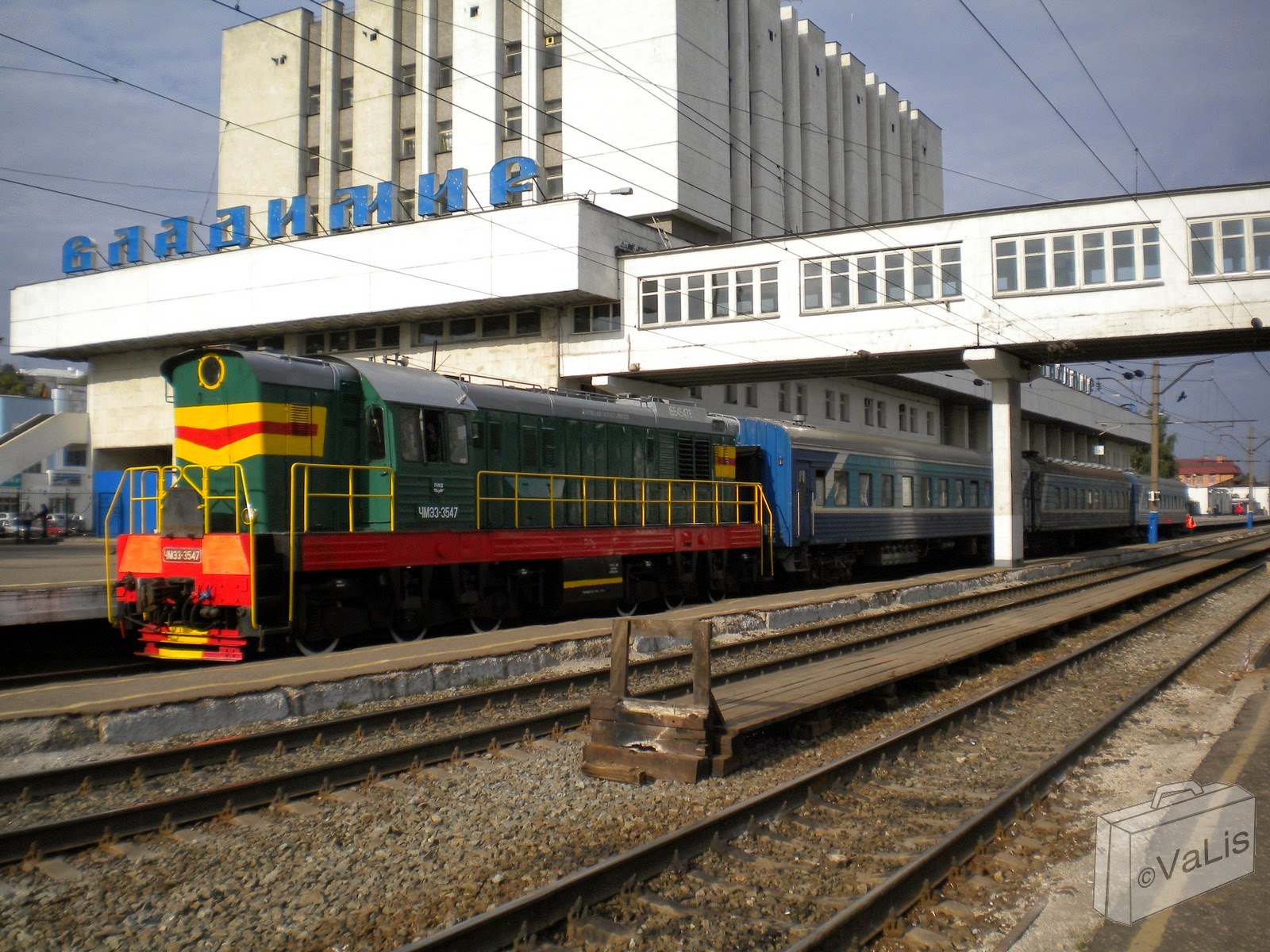
Vladimir train station

From Vladimir our TransSib adventure really began. Our first leg was a long one: 60 hours! In this long strech we crossed from Europe into Asia. During the Europian part we passed villages and forrest, mostly deciduous trees, turning into autumn foliage. Over the days the view changed into pine trees and taiga, villages getting scarcer.
The intriguing part is that you can see autumn arrive as in fast forward because the climate changes from a moderate continental to a taiga (subarctic) climate.

The Europe-Asia border marker

We delibiratly chose to do one long haul in our journey, as to really get the feeling of TransSib train travel. And we weren't dissapointed, in just this part of our journey we crossed 6 timezones!

To see a little bit of Russia as well, we took a small (6hour) break from the train in Krasnoyarsk.
We left our luggage at the station and went around town for a walk. It was sunny but there was a definite chill in the air. We completely missed the temperature drop due to the warm enclosure of our train!

Mosaic mural at Krasnoyarsk station featuring Lenin
Our next leg was an 18-hour stretch to Irkutzk, one of the biggest cities in Siberia. We spent most of our time there on Olkhon island. The day before we left, was pretty weird weather wise:

In the morning we walked to one of the monastries, just across the river. The weather was nice and sunny, just walking short sleeved, maybe 20'C.
On our walk back, the wind suddely picked up and we were hit by a sand storm, hiding in a bus stop shelter. The temperature must've dropped 10 degrees in half an hour.
That evening we had dinner in a restaurant, when we left: there was snow!!

Snow in september in Siberia
From Irkutsk we made a short hop (8 hours) to Ulan Ude, a very little visited city in Buryata. And with reason, altough we did manage to see the largest Lenin head in the world.
Next stop was Ulan Bataar, capitla of Mongolia! This takes about 24 hours, mostly because of the extensive border controlls. The tipical thing: you cannot buy food anywhere on this stretch, so be warned... we had just a few dry biscuits in 24 hours!

Sunrise over Ulan Bataar station
The weather in Mongolia was cold during the most of the days, freezing at night. But in the sunshine it was lovely,being in a desert meant no rain or snow, of course!
When we crossed into China, it was obvious we were travelling south, since the temperature increased while we were well into October.
We decided to no travele directly to Beijing, but to make a stop in Datong first.  This ment we arrived in Beijing on October 11.

Tickers for the last few hours on to Beijing

*) Moscow day is the day that commemorates the founding of the city. It was more like a week of celebrating, including a close down of the Red Square for military parades and Tversakya (the BIG 10 lane boulevard leading to the Red Square) closed to alle vehicles and filled with DJs, dance shows and balloons. Amazing! 

Friday, 12 September 2014

Staring over the water - Olkhon Island

Since I've been writing on this blog I quite regularly flip through my photos. And as it says in the header: a story for every photo is certainly true. Every photo, or set of photos, evokes a memory.
Oh my..... I might just be turning into one of those old people that keeps on telling stories of the things I've seen and the places I've been. But then again, that's what this blog is for!

The cliff next to Nikita's in Khuzhir

So... Olkhon Island... One of the places I've been. Now, for most people this might not sound familiar. Olkhon Island is the largest Island in Lake Baikal. Lake Baikal is the most voluminous, deepest, clearest and probability oldest lake on earth.

And in the middle of Siberia.

The steep cliffs (look at the car!) of nothern Olkhon

Olkhon Island is an important spiritual place in the Buryat of the shamanistic religion. Since it is a shamanistic practice to leave a token or offering at a sacret place you'll see many trees or rocks packed in scarfs, ropes or plastics. Blue being the prevalent colour, since blue represents heaven and peace.

Sacret spot near Choboi Cape

The island itself has indeed a mystical feel to it. It's hard to describe but  most of the people I spoke to that have been there feel the same.
Of course it can be caused by the omnipresent blue scarfs, or mayby because of the rugged, primal nature. The island and lake were formed a long time go, and haven't changed a lot since.

Sandy beach with freezing water

Olkhon is still rather primitive. There is no asphalt on the island. Or showers. But you can use the banya!
And during several months a year Olkhon Island is cut of from the world.

In the summer you can take a ferry, and in winter there is a hovercraft over the ice. But during the months that the ice is too think to sail through and too thin to drive over, you simple can't get there.

I think it's a special, mystical place. So.. if you find yourself in Siberia; don't forget to spend a few night at Olkhon Island!

Sunset over Lake Baikal

Friday, 25 July 2014

Gobi on a glance


In 2009 we've done a 'big trip': continuous travel for 5 months, highly recommended to anyone! :)
Of those 5 months we spent 3,5 weeks in Mongolia, and 1 week in de Gobi desert.

To give a brief factual introduction, Mongolia (wedged between China and Russia) is :
  • the 19th biggest country in the world;
  • while it's population at the 140th place:very few countries are as sparcely populated with about 1,6 persons per square kilometer;
  • 40% of the population live in the capital UlaanBaataar;
  • 30% of the population is nomadic or semi nomadic.
Most of the country is, specially through my Western eyes, incredibly empty. The vastness and emptyness of the country was overwhelming.


It's hard to describe our desert week, because it was impressive on so many different levels. We went into the Gobi in a minivan with driver and tour guide and a total of 6 tourists a visited different sites. We covered approx. 1600km, of which 100km were paved.


Sturdy minivan, only one flat tire.

In the Gobi we hardly found anything that we thought even remotely resembled a road. Thank god for our knowledgeable driver! The Mongols of course do travel through te Gobi, as they have for centuries. As a remnant you find ovoos all over the 'routes'. An ovoo is a type of shamanistic cairn, usually made from rocks or from wood. Ovoos are often found at the top of mountains and in high places, like mountain passes. They serve mainly as religious sites, used in worship of the mountains and the sky as well as in Buddhist ceremonies, but often are also landmarks.
When travelling, it is custom to stop and circle an ovoo three times in clockwise direction, in order to have a safer journey. Usually, rocks are picked up from the ground and added to the pile. Also, one may leave offerings in the form of sweets, money, milk, or vodka.


Sunset over an ovoo


In another post I'll tell a bit more about specific places we've visited. But Bayanzag is on of the most impressive sites.  In English the site is known as the 'Flaming cliffs'. Bayanzag became known because the world first fossilized dinosour eggs were found here.
Fun Fact: Bayanzag was named by the American American paleontologist Roy Chapman Andrews. Some say Indiana Jones was based on Andrews....
 
Bayanzag