Showing posts with label Asia. Show all posts

Friday, 17 June 2016

And so it starts

After months of waiting, preparing and thinking, finally the first week of our vacation is there! Our plans were: Friday party prepping, Saturday Rodie's birthday bash, and then just some packing and cleaning to do before we hand over the keys to our renter in Wednesday, then 1 night at Rodie's mum before we catch a plane on Thursday, arriving in Cairns Saturday morning. That were our plans at least...

It started out really good, had a lovely party with talks and hugs abound. But then came Tuesday morning... And bad weather. When I was packing our clothes into boxes a I suddenly heard the sound of cascading water... Inside the house? A quick run revealed the source of the clattering: we had a major leak in our kitchen! Rain just poured in! Of course a day before our renter would move in.  
Some quick phone calls and lovely helping friends further, it looks like we solved that problem. Luckily our renter was very understanding, and now there's just some painting left to do, but what an adrenaline rush! Not the most relaxing way to move out, I can tell you that.  

Anyway... We slept at Rodie's mum that night, and after an early breakfast headed to Schiphol Airport. We booked a flight that would leave at noon, and arrived at 9:15. And then couldn't find our flight at the departure overviews... Oh oh... After franticly checking our flight number it turned out our flight was scheduled to leave at 11:15. Whoops. Good thing we arrived early!
In the end our flight was delayed and we left at 12:15. After a 13 hour flight with lots of turbulence, we arrived in Singapore just in time to see the sunrise. 


We have a 20 hour stopover in Singapore, and we had decided before we left, that if we felt like it, we would book a room at one of the transit hotels. After all, we're not that youthful anymore and love to sleep in a proper bed.  And oh boy, we were knackered when we came out of the plane! Although it was 7am in Singapore, in our biological time zone it was 1am. A room was available at 8:30am, so we booked it for 8hours.  What a good choice! It costs S$20 per hour, but so worth it. We got a nice room with two good beds, a clean and spacious bathroom and after we checked out of our room we got a complimentary meal and unlimited access to the lounge area (with free coffee!) and the rooftop pool. That is where I'm typing this little blogpost just now. 
If you haven't been to Singapore before you can always choose to do one of the free city tours, but we are happy with our choice so far. 

Friday, 19 February 2016

Traditional temple stay - Koya San

Japans Kii peninsula has long been a mystic area, and therefor is littered with sacred sites. Koya San is one of them. This is where the tomb of Kobo Dashi: the founder of the Shingon school of Buddhism, is. Koya San is a mountain, or rather a plateau, where you will find more temples than houses. The place to spend the night here, is of course in one of these temples. So we did.

Cable car up the mountain 

We took a train from Osaka to the base of the mountain. Once there,  a steep ride with the cable car brings you to the top.  We took bus for the final leg to 'our temple': Muryoko-in.  Once registered, we got our slippers, and a monk showed us to our room.
This was a simple Japanese room: separated by paper walls, futons to sleep on, a few cushions to sit on and yukata (casual kimono) to wear.

Our room, with red slippers in the hallway

After our check in we walked a bit through the town, and then back to our room for dinner. This was a traditional Buddhist dinner: vegetarian and without strong smelling ingredients like garlic or onions. With a quiet knock on the door the monk announced his arrival, and then entered the room with neatly stacked tray tables. Like all food in Japan, this was beautifully displayed.  And tasty too!

Dinner is served

After dinner we took a quick dip in the traditional (shared) Ofuro, layed out our futons and were asleep by 10 pm. The next morning our alarm was set to 5 am! 
We had been invited to join the Gotomaki fire ritual, and being in a temple, we really wanted to. With some other guests, we sat in the back row of the ceremonial room.  The ceremony took about 80 minutes and we both were really glad we were there.  What was it like?

The room was very dimly lit, and one monk was continuously chanting. The other monks joined him intermittently. A fire burned, being fed by one of the younger monks. The whole esoteric atmosphere kind of drew us in. At the end we were invited to participate by adding to the fire and joining the final chant. We didn't take photos but just enjoyed it.

Koya San street view

During our visit a Swiss monk lived in the temple, and he invited us for a little chat afterwards. While drinking tea with some sweets he explained the ritual, the different elements of the Shingon Buddhism and temple live in general. This really added that bit extra to our temple stay. And after our chat.... it was time for breakfast, which we had in a communal room with the other guests.

One of our breakfast dishes

Friday, 2 October 2015

Timetravel

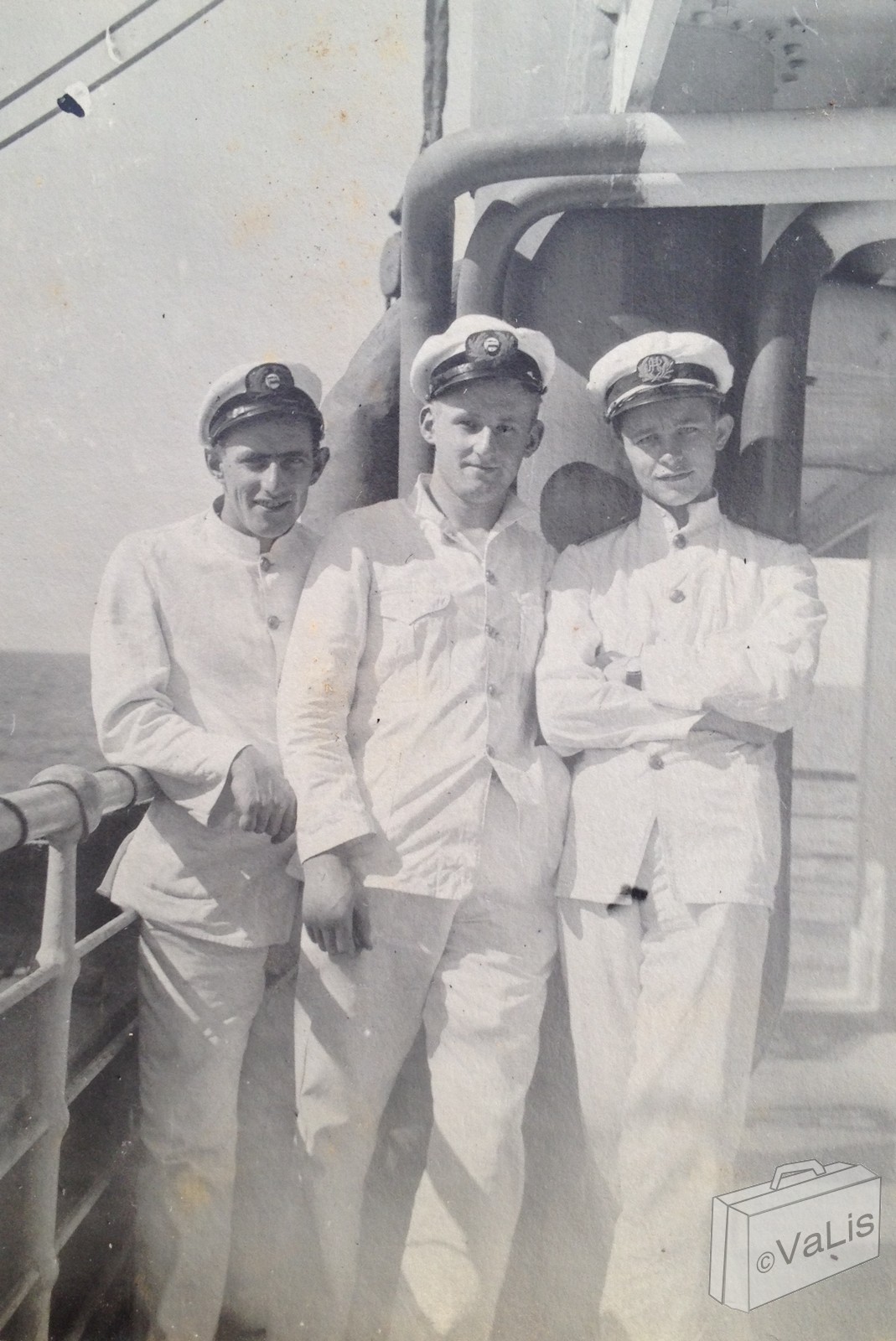
This is a bit of a different post than the usual, but for me a very special one! I have always known that my grandfather had sailed the world when he was younger. On of the reasons I know is that I was always in awe when he told little snippets about that time. And I simply could not believe the places he had been. Maybe the seed of my wanderlust has been planted by him? Or it could be the genes.

My grandfather is the lovely young sailor on the right

Anyway. A few weeks back I learned from a Facebook post that my grandfather had made some photo albums of  his sailing period, and that my aunt had those!  She was kind enough to let me borrow them, and I spent my afternoon looking through them. Really amazing. All he countries he has been to: Mexico, Cuba, India, China, Japan and the Philippines to name a few.


Shanghai. If you look closely you recognize the clocktower in the middel of both photos

Now... my grandfather was born in 1903, and he travelled in the 1920s and 1930s. A truely exiting time. In his albums are progress pictures of the Sidney Harbour bridge and of the Bund in Shanghai without skyscrapers.
But the photos of his life on board are fascinating as well. The interiors of some of the boats!

Both my grandfather and I started travelling outside Europe in our early twenties, but that is an eighty years time difference. I am just humbled and exited at the same time to see how many places we have both visited, but almost a century apart. I keep looking at his photos and than at mine. Finding the differences and similarities.


Nagasaki. Suwa shrine entrance

I loved seeing his photos from Japan: This was the country he talked about most with me, and I am sure my fascination for Japan came from those chats. I visited  Japan last year, and it turns out we have both visited quite a few the same places.  And then I saw the photo from Nagasaki, and it suddenly hit me: he visited before the A-bomb.

As it happens his only photo from Nagasaki was from the only shrine that has not be damaged during the war.

Tuesday, 23 June 2015

Pandas in the mist... - Chengdu

Of course, when you're travelling through China for some time, you HAVE to see its national symbol: panda bears!
China is very proud of them, and very protective. In a Chinese manner. So while their natural habitat keeps diminishing, serious money goes into breeding programs. One of the main, and very accessible, breeding facilities is in Chengdu. So that is where we went. And Chengdu in November turned out to be extra wet and foggy.

Panda's coming out into the mist

The panda centre is a little out of town. You can take a local bus, or book a tour with the place where you are staying. We stayed at a lovely hostel, and booked our transport through them. After paying the entrance fee you can wander through the park. The park looked much better, and more animal friendly, than we expected.
Though, as you can see from the photos, it was sometimes even hard to see the pandas in the mist!

One of the enclosures for the youngsters, food and exercise

Like in the wild, the pandas spend most of their time eating. Since pandas eat bamboo, one of the least nutritious foods one can imagine (for carnivores!), getting enough food in, is their main concern. Maybe their only concern, since pandas are not known for their breeding capacity.... That's where the breeding centers come into focus.

Always eating!

Because of the low calory intake, the panda is a very inactive animal and non social animal. It all requires just too much energy! And to make it even more of a challange: a female panda is fertil for about 23-36 hours per YEAR...
If a panda manages to get pregnant against all odds (or by AI), she usually gives birth to twins. But since a panda does not have enough milk for both, she only takes care of the stronger twin. To let it survive, the weaker cub is separated from the mother, and raised in a nursery. We were not allowed to visit the nursery, but could quietly walk passed the 'visiting window'.

About 2 week old cub

After about two years the cubs spend a few years in 'play groups' of 4-5 individuals, until they come to an age that they do no langer want to be sociable. The older animals al live solitary, as is their nature. But until then, they are super cute to watch!

You should relax while eating

Thursday, 4 June 2015

BBQ Korean style - Seoul

If you ask Koreans for dinner recommandations, you can be sure most will say Korean barbecue is the way to go. So naturally, that's what we had. Several times.
Korean barbecue has different name depending on the type and cut of meat that you order.

Informal Samyeopsal place

The first night in Seoul went out for Samgyeopsal (삼겹살) in a busy, informal eatery. Samgyeopsal is pork belly barbecue. We sat down at a little table/barbecue made from a drum, and ordered meat for three people. When you place you order, they fire up the barbecue, and the little side dishes are served. These side dishes are called banchan (반찬).You do not have any saying in the side dishes you'll get. That's for the kitchen to decide. But you can be sure there will be at least one dish of kimchi (김치).

Barbecue with side dishes

Once your meat is cooked, the fun continues. Along with the banchan you got some greens. This can be different types of lettuce, and usually you also get a few wild sesame (perilla) leaves. Put a piece of meat on there, add some sauces and/or veggies, fold the leaf and enjoy your bundle of yumminess.
Generally the staff will help you with cooking, or take over if they think you are not cooking it correctly: we smoked out that first place! Whoops....

Consecutive steps of our 2nd barbecue

So we had another go a few nights later. In a slightly fancier restaurant that had electric cooking plates installed in the table. We picked a leaner cut of pork this time. In this restaurant, the ritual started with some vegetables on the plate, carefully put in the correct position. Then the meat was put on there, and..... cut into strips with the ultimate Korean cooking utensil: scissors.
The strips were cooked, and then flambéed.
After this dinner, a dessert was cooked on that same plate, consisting of rice and cheese.

In a supermarket, pretty lettuce is slod by the leaf!

Our third and final barbecue was in Jeju-si, with the famous Jeju black pig. This time was a combination of the previous barbecues. A fancy table plate with streaky belly meat. The people at the table next to us were no shy in telling us if we did something wrong. We had to place the giant mushroom at the correct position (left side, not right side), cook the meat longer before cutting it, and not put the veggies on there just yet. Did I mention the Koreans are quite fond of doing things in the correct manner?

Barbecue basics: banchan, leaves and scissors

Since these barbecues tend to be smelly, you can always get a big plastic bag to put your coats in. You can order drinks with you meal, but water is served for free in any restaurant.

Wednesday, 29 April 2015

Korean cultural snippets - South of the DMZ

It's been a while since I posted anything. The main reason is that I've been too busy working, but I have made a quick trip to Korea as well! And even though we have spent a fortnight there, which isn't really short I you think about it objectively, it did feel like a quick trip!

Memorial Park in Munsan
So this post is about my first impressions of Korea. It felt to me like a mixture of Chinese and Japanese. Which is probably true. Korea has long been a satelite state of the Chinese imperium, and later has been occupied by Japan. So the noise definitely sounded Chinese to me, but the way things are done in a set manner, the emphasis on the 'correct way' of doning anything, reminded me very much of Japan.

View over Munsan (to the north)
And the fact that Korea has been in a permanent state of war since the 1950's does show. The people themselfs do not seem very concerned with it. But for us tourists, it was quite visible in places.
We visited our friend, who lives in the border town Munsan (1 hour north of Seoul), and we decided to go on a morning walk in the surrounding country side. The path started right behind the memorial park. And then passed trenches and foxholes, not used at that moment, but very well maintained. But it was quite busy that morning with other hikers and no one but us seemed to notice the millitary appearance.

Walking past trenches
Now.... the correct manner to go hiking in Korea. Firstly, you need to wear the proper hiking gear. That means: hiking trousers in a bright colour, with black patches on the inside of you legs. A matching long sleeved, light wear jacket. Both in this season's colour. The seasonal colours this spring were orange or pink, we were told that last autumn they were burgundy and mustard.
Under your jacket you wear a long sleeved shirt, the woman wear a large sunshade and the man a cap, and every one wears trainers with neon laces. Of course you carry a backpack. Optional accesoires are walking poles, bandana and gloves.

Typical Korean hiker (from SFA)


Sunday, 15 March 2015

Spirit of days past - Baga Gazriin Chuluu

One of the first stops we made on our little tour thru the Gobi was near the rock formations of Baga Gazriin Chuluu.  Legend says that this is where Ghengis Khan grazed his horse, but then again, Ghengis must have grazed his horses a lot...

Roads in the Gobi

Anyway, even though for us tourists the 'roads' in the desert were not always obvious, it was obvious that many people travelled to this spot by the number of ovoos. (More info in this post)
Baga Gazriin Chuluu is also where the Delgeriin Choiriin Khiid monastry used to be. Before the Russian occupation of Mongolia, most of Mongolia held Buddhism as it's religion: in a land of a nomadic people and thus mostly temporary buildings, there were over 3000 temples in the early 1930's.

Looking down at our minivan

That all changed during the Purge, and by the late 1940 only one temple was left. The number of monks had dropped in two decades from more than 100.000 to a mere 100. 
This is the reason that Delgeriin Choiriin Khiid was abandoned and had fallen into ruin.

The abandoned grounds

When you walk onto the grounds of Delgeriin Choiriin Khiid the feeling of sadness is overwhelming. There are still many (small) trees there, a rare sight in the desert. Remnants of a past life.
It feels like a sacred site. A place to ponder.

A place to ponder

An occasional scarf is tied around a tree, to emphasize the sacred purpose of this site. When I googled, I found out that since our visit in 2009, reconstruction has begon of the temple, like many other Buddhist sites. For now a temporary temple is set up in a ger in the plain in front of the original site. Visitors can stay overnight in surrounding gers.

Friday, 27 February 2015

Something fishy - Tsukiji Market Tokyo

When you google at 'top things to do in Tokyo' you can almost be sure that Tsukiji fish market will pop up, most notably the tuna auction.
Being a food market lover myself, I really wanted to go there. But... the tuna auction starts at 6 am. And only a limited number of tourists are allowed to attend, so you have to queue at around 4 am. There is no public transport at that time of night (oddly enough Tokyo's public transport stops around midnight?!) so you have to either walk there, take a cab, or wait over a few drinks at one of the nearby pubs.  We opted out of attending the tuna auction, bad tourists...I know!

One of the small stalls

At around 8 am the rest of the inner market opens up to visitors, so there we were. Surrounded by tour groups, we entered the public space.

And now I hear you wondering...How was it??? First impression: way more tourists  than expected, and at the same time less of a tourist trap than expected.  First and foremost, this is a place where people work, no signs which way to go or defined routes. This also means that you have to be carefull not to be overrun by one of the funny, and very fast, carts. Even  though there is hardly any room to walk in between the stalls, the carts race past!

Tuna waiting for a buyer

The fish and seafood they sell is simply amazingly fresh and varies from extraordinary to bizar.  And it is a lot.  The sheer number of sea creatures on sale was mindblowing. It really made us wonder how much longer it takes to empty the oceans.

Super size mollusc

Of course there was an abundance of tuna. Al tuna arrives deeply frozen. Did you know that those beautifull slices of sashimi are precut in to blocks, while frozen, with a industrial band saw? I didn't!

I saw the biggest mussles I ever saw: at least 3 times the size of my hands. Crates of roe, alien crustaceans, unknown molluscs, vibrant octopi and fish in alls size and sorts inlcuding some wiggly, still alive, skewered fish.


Sawing sashimi blocks

The traditional thing to do after visiting the Tsukiji Market is to eat fresh sushi. Most people try to do that in the inner market, but the outer market makes a good alternative if you want somwhere (slightly) less busy.  We didn't do that either... we were such lousy tourists, I know! But the massacre we had just witnessed satiated or need for animal protein.

Vibrant octopi


Saturday, 21 February 2015

Supercity - Shanghai

We had already spent 4 weeks in China at that point, mostly visiting ´culturally interesting´ sites such as Xian and Pingyao, when we arrived in Shanghai. And I loved it.  I was in need of some city life....

Pudong skyline

If you have read previous posts , you know I love the emptiness of deserts, or that humbling feeling when you encounter an animal in the wild. I think what really appeals to me, are extremes. Natural or man made. Like when you move through a vibrant metropolis like Shanghai. It reminded me of my first visit to Bangkok in 2003.

One of many little streets

Shanghai in 2009 was full of life and one massive construction site. Combine a superb metro system, chaotic train station and gigantic fly overs with futuristic highrise, traditional temples and labyrinth like residential quarters and you get the basic idea.

Bike ride: Love the contract of old and new buildings

Of course it is absolutely impossible to see all ( or even most) of the city in a few days, so we stuck to the obvious. We went to the Bund, that was under construction, with the Oriental Pearl Tower, the French concession, a few temples, some gardens, little eateries and markets.

French concession

We did a half day bike tour, a dim sum workshop, and wandered. We ate some really good and some not so good food. I love the contrast that was all around. The little boutiques and cafés in The French concession. The Chinese markets, cockroach fights and soup with indistinguishable ingredients in the traditional neighbourhoods. The incense and monks in the temples. We had a blast!

Rooftop bar at the Bund


Saturday, 31 January 2015

Island impressions - Bali

Going to Bali has never been on top of my travel list. Bali is a more touristy place than our usual destinations. But as it happened, in 2005 we went there for a family visit.  Now, who am I to complain about a destination.... right?

Dark clouds over green paddies

We slept in a local's house south of Kuta.  This gave us the chance to share the day to day life of  the extended family there. And a few house rituals were explained to us, like the mandatory daily offerings .


Temple offerings

Being Dutch, we borrowed bikes to get around town, and to go to nearby (upscale) Sanur. The bike ride to Sanur took us about an hour, and we spent a lovely afternoon with a yummy cocktail at the picture perfect beach there.

Sanur's picture perfect beach

To have some private time, away from the family, we stayed a few days in artinasal village Ubud, in the middle of the ubiquitous rice paddies.  At night we could hardly sleep for the crickets and quacking ducks. That was something different!

Rice paddy in Ubud

Every visit to Bali needs a trip to a Sacred Monkey Forest, and so we did.  We went to  Padangtegal near Ubud. The monkeys have no fear for humans whatsoever, and are used to being fed: so beware! But having food in abundance also means lots of infants, and lots of photo opportunities.

Monkey life
To see a bit more of the island we went on a roadtrip for a day, and one of the places we visited was Gunung Batur.  Gunung Batur is an active volcano, and the black land surrounding the crater is an impressive sight.

The slopes of Gunung Batur

Tuesday, 30 December 2014

Water colours - Bako

Not too far from the city of Kuching on Malaysian Borneo, situated on a peninsula, is Bako National Park. The only way to reach it, is per boat, and so we did. First we took a bus to Kampung Bako (about an hour and a half), where we chartered a boat for the last few miles.


Local  fisherman

In a teeny tiny boat we went. First out of the village, past the houses and then on to open water, where we crossed paths with local fishermen going back with their nights catch.
We arrived at Bako NP beach at low tide. This meant we couldn't moor to the pier, but had to wade the last few meters.  Of course, the water was warm enough, and only the next day we discovered the HUGE jellyfish.

The arrival beach at Bako NP

At Bako you can spend the night in very basic rooms, and so we did. We spent 3 nights in the park, which gave us enough time to leisurely explore the park. There are a some well-marked trails in the park, and you are allowed to walk the trails independently. As a safety measure, when you go out on a hike you sign in and out at the central register. In this way, if you are away for far longer than estimated, help can be sent.

Start of our hike

We did one 4-hour circular hike. It started at see level, on a wooden boardwalk underneath the trees. Then a bit up over soft soil and then climbing rocks towards the panoramic vistas. Utterly sweaty we reached the plateau of the peninsula, formed by lava, with small springs and streams cutting into the black ripples. A bit further the ground was more sandy, even dune like. The environment gradually became greener, small trees appeared and it became more humid again.

At the plateau

Then down we went, to a small secluded beach. We stayed a while, swam, washed off the sweat off, and had a snack. Then up again, back to the trail. The last stretch was steep down again, climbing down over ladders and boulders until we reached the main path around the park headquarters, where we passed a drowned forest. 

The drowned forest

On this particular hike we didn't see a lot of large animals (we did on other hikes!) but were amazed at nature's diversity at such a small patch of land: Insects, plants, soil, even without the mammals, this was a really good hike!

Pitcher plant at the plateau

Monday, 22 December 2014

People of the forest - Semenggoh

When we decided to go to Malaysian Borneo there was no question about it: we would visit one of the wildlife rescue centers in the hopes of seeing an orangutan. We chose the city of Kuching as a base for the 2,5 weeks we spent on Borneo. One of the main reasons we chose Kuching is it's proximity to Semenggoh Wildlife Centre.

There are a few different spots on Borneo where you can see semi wild orangutans. We opted for Semenggoh because it is not included in most organised tours (they tend to go to Sepilok in the east) but still accessible enough by publing transport (as opposed to Matang).

Mother and baby sighted

Semenggoh is a rehabilitation centre and the orangutans living there are thus semi wild. They are used to humans and no longer wild enough to be set free. But they can move about within the conservation area as they please.
Twice daily food is placed on feeding platforms in the reservation, but this is no guarantee the apes will show.
If there's enough food in the forest, they usually do not come to the feeding platforms. We were aware our trip might be in vain, but wanted to at least give it a try.

Mother and baby coming down to feed

From Kutching we took a bus to Semenggoh, about a 40 minute ride, so we arrived in time for the afternoon feeding session. From the bus stop it is about 20 mins walk on a paved road to the feeding platform.
In the past you were allowed to walk ther over paths through the forest, but since the current alpha male is too aggressive the paths have been closed to humans. I think that's a good sign for the apes, don't you? The rules are set to make the orangutans more comfortable, not the humans.

Aplha male Ritchy on the feeding platform

As we waited near the platform, we could read a bit on the individual history of each ape and the family relationships. Within the reservation the apes are comfortable enough to breed!
We had good hopes of spotting an orangutan since it was past the fruit season, which means less food to find in the forest. We were not dissapointed! Our first sighting were a mother and child! Still fairly high up in the trees, but who cares?? This was more than we had hoped for!

Edwin had so many facial expresions!

As the rangers placed some food on the platform, they came further down and started munching. But suddenly then she went up again!
It soon became clear why: the trees started swaying... and Ritchy came down! Ritchy is the current alpha male, and an impressive sight, even from the safe distance we kept.
We stayed another hour or so to watch the apes eat and interact. A few more oranutangs came down, including the comical Edwin. Utterly satisfied with our sightings we went back to Kutching.

Enjoying lunch

But before we left Borneo we decided to try our luck again... so a fortnight later we visited Semenggoh for the second time.  An even more impressive visit.
This time we saw another mother and child, both a bit older than the previous visit. The youngster was happily eating his banana inside 'our' viewing hut. And because visitors have to keep their distance from the residants, this meant that the humans were standing in the blazing sun, while the apes were enjoying a lunch in the shade: imagine that!

Ritchy: 150kg of muscle

Then suddenly the mother started walking, and the rangers appeared very concerned. Another visit by Ritchy! But this time not on the feeding platform. He followed suit and decided to have lunch in the hut as well.
And if Ritchy does that, you show respect. An adult male orangutan can litteraly rip you apart. So the humans were hoarded out of his way, while leaving room for the moher a child orangutan that were leaving. (We learned that since she had a young child to care for, she did not want to be impregnated and therefor stayed away from the alpha male.) It was a very crowded  parking lot! Even more so when Ritchy decided to follow the others...

Mother and child hurrying away

Luckily all went well in the end, and the rangers made sure to keep as much distance between the human and apes as possible. The only thing was that Ritchy decided to sit down right next to the road, and do some people watching. The same road we had to walk to get to the bus stop.....
After some time, we knew we had to start walking. The last bus of the day would be there in half an hour. But what about Ritchy?
After strict instructions from the rangers, do not look at him, no camera sounds, no photos, no talking etc. we walked passed him, as far to the other side of the road as possible, but still only 6 meters away!  Equally impressive as scary if you ask me, but what an experience... Definitly a top 10 visit!

Ritchy near the road, seeing us off