Saturday, 4 October 2014

Train Life - Trans Siberian

When we did (part of) the Trans Siberian train, there are a few thing we had to take into account. Because knowing this made our train life easier, and more fun, so I thought I'd share them.

Train life

Some TransSib basics:

  • The lower the train number, the faster the train. The Rossya (Red train) is the number 1 towards Vladivostok and the number 2 goes towards Moscow. This is the fastest train. It takes 7 days for the entire trip. Most of the route is single track, this means you might wait for 10-90 minutes at a station for a lower numbered train to pass. 
  • For express trains (all numbered trains) you have to reserve a seat/betrh. A seat always equals a berth on overnight trains. You can make a reservation at the counter of a train station or through an (online) agency. Bedding is provided (a top and bottom sheet, a pillowcase and a towel)
  • Most trains continue for several days, but not all trains continue along the entire route.  
  • There are 4 classes on express trains: platzcart (bunk bed carriage), kupe (4 bed compartments) and spalny vagon (2 bed compartments) and luxe (1st class).
  • Bring your own (instant) food, and supplement with foods sold at the platforms or in the train. 

Passing Lake Baikal

Booking

We've booked most of our tickets through an internet agency (Real Russia). And that worked really well! We could pick up our tickets at St. Petersburg station by simply showing the lady at the counter our passports and picked the other up at the Moscow office.
The major plus, we found, was that booking through this agency meant we travelled in the carriage with the Russian folks.We met some other tourists that booked with a non Russian agency and they we all seated together in the first carriage. That would be missing most of the fun!

Another option is to book through a hostel or at the counter of the train station. The last option is a bit adventurous, since most of the people speak only Russian. But since they generally would like to help you, usually a means of communicating is found. Either by writing, pointing or with the help of a random student passing by...

Another advantage of booking through a local agency is that you can decide to book platzcart (3rd class). A service not reguarly offered by non Russian agencies.

Krasnoyarsk station

 Classes

The cheapest class is platzcart, or 3rd class. Platzcart is a open carriage, bunk bed style. There are 54 beds in each carriage.  

Two beds above one another, the lower bed is used as seating during the day. So if you plan on lying down a lot, choose a upper bunk! The upper bed is a bit claustrophobic.
One row of beds is orientated lengthwise (so if you're quite tall, your feet might not fit in), then the aisle, then the transversal beds: 2*2 per 'cabin'.

Platzcart carriage
We were quite curious what platzcart would be like, but not adventurous enough took book 3 nights without knowing what it would be like. 
This class has the most people per carriage, so not a lot of privacy, but more than adequate to spend 1 or 2 nights in. Since this is a cheaper class, people here tend to speak less English or German.
But you might meet a student avid on practicing his English, as we did.
And if you are a single woman travelling, you might want to consider platzcart: less privacy but more social monitoring.

Kupe is the class we travelled in for the longer hauls; 2nd class, 4 bed compartments. We travelled as a couple, and this provided some interaction with locals, without the complete lack of privacy in platzcart. The compartment can be closed with a sliding door, and the aisle is usually the place to chat, walk and meet more travellers.
In the compartment were 2*2 bunkbeds, the lower beds again used for seating during the day. There are 9 compartments, so a maximum of 36 people in a carriage.

Aisle in kupe carriage


Toilet facilities

All carriages have 2 bathrooms at either end that are shared between all passengers. These have a toilet and a sink, but no shower. You can get very inventive with this (I've heard of someone filling a soda bottle with lukwarm water, punching holes in the bottom and using that as a shower) but I reckon baby whipes serve a purpose here...

Train attendent - provodniza

Every carriage has 2 train attendents (provodiniza) that are in charge of daily affairs. They check your ticket, provide bedding and clean! How often and how well your bathroom (and the aisle) is cleaned depends largly on you provodniza, but we were happy with it.Once we were shooed into the compartment because the carpet in the aisle needed to be vacuumed and turned!


Food

Oh... the food! Where to start?  Ehm.. Let's say I am not a huge fan of Russian food. As I told some friends: I feel like they have a deep fear of spices and herbs... Most of it is just pretty bland for my liking. But maybe I haven't tried the right places or foods.

Culinary highlights
All carriages on the train have a samovar; a boiler filled with hot water. You can use this freely to make coffee, tea or instant foods. We packed instant noodles, soups and other instant 'delicacies'.

When the train stop, there are usually some locals selling their cooking the platform. This may vary from meatballs (frikadelki) to apples (bloko), to pancakes (blini) and others. The further east you go, the more common it is to see this. But not on all stations so do NOT count on it.

The 3rd option is of course: buy food on the train! Most provodnizas have a little business going on, so you can buy some basics with them. Tea, served with sugar in a pretty glass, chocolate, biscuits etc.
Some trains have a restaurant car, but we've never made it to one of those, so I can't tell you al lot about them.

Platform bought food

What route to take?

This is a hard one! There are 3 main routes:
  • Trans Siberian (Moscow to Vladivostok)
  • Trans Manchurian (Moscow to Beijing)
  • Trans Mongolian (Moscow to Beijing via Mongolia)
To do an entire stretch without stopping takes about 7 days in a fast train. 
It really comes dowd to what you prefer...
What destination: Vladivostok or Beijing?
If you want to visit different interesting places means you'll make more stops en route. 
If you want to get into train life you might want to take on long trip without stops.

To see what we ended up doing, visit this post.


Saturday, 27 September 2014

Summer into winter in 7 days - Trans Siberian

This week I was triggered by another blog: subject... train travel.
One of my favourite trips so far, was the journey from the Netherlands to Bangkok by public transport, mainly trains.

I'm a long time fan of train travel, and when we started to plan this particular trip our starting point was one of the most epic trains ever: The Trans Siberian.
We ended up not doing the Trans Siberian, but the Trans Mogolian, but I'm sure at some point we will do the actual Trans Siberian.

A ticket for every hop
Now, as with every blog, I start by flipping through photos to get me into blogging 'mood'. What triggers a fun memory, or which photo do I want to show? But there is so much I can or want to tell about the TransSib! So I decided to split it up into different posts. This will be my first of a series! Consider it an intro...

In 2009 we travelled through Russia  for 4 weeks, starting late August. This made us just in time for celebrating the end of summer in St. Petersburg and Moscow day* in shorts, and the start of winter in Siberia.

Our Trans Siberian itenerary was:
6/9 Local train (elektrichka) from Moscow to Vladimir, 200 km, 3.5 hours 
8/9 Train 092 from Vladimir to Krasnoyarsk, in kupe class, 3900 km, 60 hours
11/9 Train 270 from Krasnoyarsk to Irkutsk, in platzcart class, 1100 km, 18.5 hours
19/9 Train 070 from Irkutsk to Ulan Ude, in platzcart class, 450 km, 8 hours
21/9 Train 362 from Ulan Ude to Ulan Bator, in kupe class, 650 km, 23 hours
6/10 Train K24 from Ulan Bator to Datong, soft sleeper class, 1300 km, 25 hours
11/10 Train K616 from Datong to Beijing, hard sleeper class, 400 km, 6.5 hours


Interior of an elektrichka class train
Before really embarking on our TransSib, we wanted to go to on of the Golden Ring towns encircling Moscow. We decided on Suzdal: a bus ride away from Vladimir on the TransSib route. Since it's such an short ride, you can take a local train.
You don't have te reserve a seat in an elektrichka as you have to do at an express train. Just show up at the correct train station (Moscow has a mere 15 train stations) and buy a ticket at the counter, in Russian of course.

The trip to Vladimir took 3.5 hours, on wooden benches... and I was tired enough to sleep through most of it! We spent 2 nights in Suzdal, a tiny little Golden Ring town, with more churches than people. And of course no one spoke anything but Russian there!

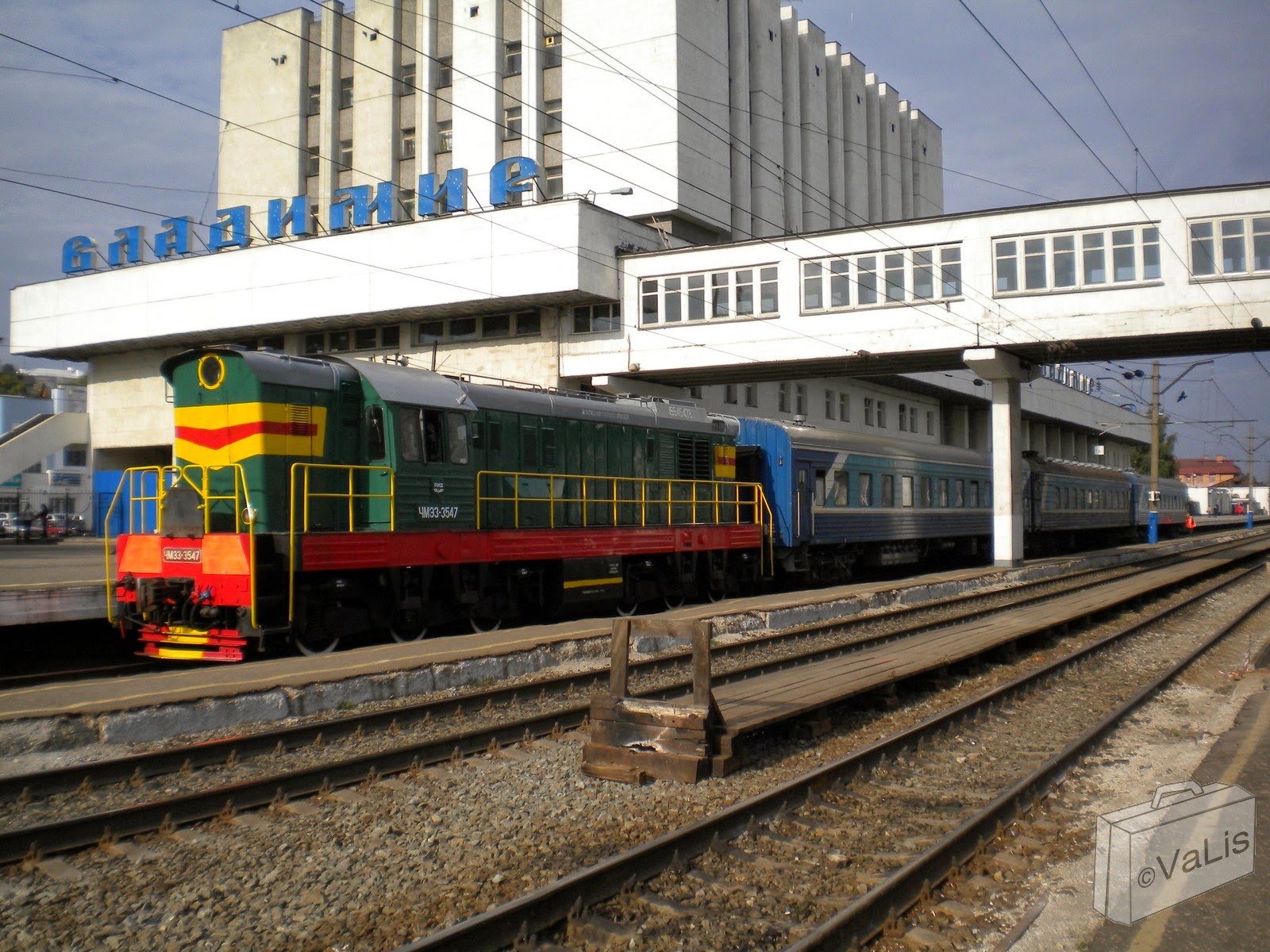
Vladimir train station

From Vladimir our TransSib adventure really began. Our first leg was a long one: 60 hours! In this long strech we crossed from Europe into Asia. During the Europian part we passed villages and forrest, mostly deciduous trees, turning into autumn foliage. Over the days the view changed into pine trees and taiga, villages getting scarcer.
The intriguing part is that you can see autumn arrive as in fast forward because the climate changes from a moderate continental to a taiga (subarctic) climate.

The Europe-Asia border marker

We delibiratly chose to do one long haul in our journey, as to really get the feeling of TransSib train travel. And we weren't dissapointed, in just this part of our journey we crossed 6 timezones!

To see a little bit of Russia as well, we took a small (6hour) break from the train in Krasnoyarsk.
We left our luggage at the station and went around town for a walk. It was sunny but there was a definite chill in the air. We completely missed the temperature drop due to the warm enclosure of our train!

Mosaic mural at Krasnoyarsk station featuring Lenin
Our next leg was an 18-hour stretch to Irkutzk, one of the biggest cities in Siberia. We spent most of our time there on Olkhon island. The day before we left, was pretty weird weather wise:

In the morning we walked to one of the monastries, just across the river. The weather was nice and sunny, just walking short sleeved, maybe 20'C.
On our walk back, the wind suddely picked up and we were hit by a sand storm, hiding in a bus stop shelter. The temperature must've dropped 10 degrees in half an hour.
That evening we had dinner in a restaurant, when we left: there was snow!!

Snow in september in Siberia
From Irkutsk we made a short hop (8 hours) to Ulan Ude, a very little visited city in Buryata. And with reason, altough we did manage to see the largest Lenin head in the world.
Next stop was Ulan Bataar, capitla of Mongolia! This takes about 24 hours, mostly because of the extensive border controlls. The tipical thing: you cannot buy food anywhere on this stretch, so be warned... we had just a few dry biscuits in 24 hours!

Sunrise over Ulan Bataar station
The weather in Mongolia was cold during the most of the days, freezing at night. But in the sunshine it was lovely,being in a desert meant no rain or snow, of course!
When we crossed into China, it was obvious we were travelling south, since the temperature increased while we were well into October.
We decided to no travele directly to Beijing, but to make a stop in Datong first.  This ment we arrived in Beijing on October 11.

Tickers for the last few hours on to Beijing

*) Moscow day is the day that commemorates the founding of the city. It was more like a week of celebrating, including a close down of the Red Square for military parades and Tversakya (the BIG 10 lane boulevard leading to the Red Square) closed to alle vehicles and filled with DJs, dance shows and balloons. Amazing! 

Friday, 19 September 2014

Small wonders - Cuc Phuong

During our trip in Viet Nam, of course we planned to vist Sa Pa, known for his hill tribes, as well. But... things didn't go as planned.
The day before we intended to take the train out of Hanoi a typhoon ravaged the North. Landslides, deaths and touristst helicoptered out of there made it obvious we couldn't go there.

Spider and prey
We needed an alternative. We decided on Cuc Phuong: a National Park south of Hanoi. Due to the use of agent orange most of Viet Nam's jungle was destroyed.*  Luckily jungle is a resilient thing and it grew back.

Reproduction in progress

The animal population takes longer to reestablish, specially the mammals. This is caused by two major reasons: The larger the animal the slower the reproduction rate (generally speaking). Another reasn in ths specific country is the poor population. If you're hungry any animal is edible, and that happened on a large scale.

Spot the lizard...
Fortunatly there are several animal rescue centers and breeding programs. And for us visitors it is a good place to appriciate the smaller wonders of the animal spectrum.

Although.... it seems like some of the insects have taken on gigantic proportions... ! May be trying to compensate for the lack of mammals?

Ridiculously big stick insect
In the end we had a great two days in Cuc Phoung. The jungle visit was impressive, so were the rescue centers, and there are also some interesting archeologically interesting caves to visit. This is appareatly one of the oldest places of human settlement.
But again... watch the creep crawlies when visiting!

Bats in a archeological cave


*) Agent orange is a herbicite. The US army spayed it with planes in copious amounts during the Vietnam war to defoliate the leafy jungle, thus destroying North Vietnames soldiers's hiding places and ambushes. Needless to say it was toxic for humans and animals too.

Friday, 12 September 2014

Staring over the water - Olkhon Island

Since I've been writing on this blog I quite regularly flip through my photos. And as it says in the header: a story for every photo is certainly true. Every photo, or set of photos, evokes a memory.
Oh my..... I might just be turning into one of those old people that keeps on telling stories of the things I've seen and the places I've been. But then again, that's what this blog is for!

The cliff next to Nikita's in Khuzhir

So... Olkhon Island... One of the places I've been. Now, for most people this might not sound familiar. Olkhon Island is the largest Island in Lake Baikal. Lake Baikal is the most voluminous, deepest, clearest and probability oldest lake on earth.

And in the middle of Siberia.

The steep cliffs (look at the car!) of nothern Olkhon

Olkhon Island is an important spiritual place in the Buryat of the shamanistic religion. Since it is a shamanistic practice to leave a token or offering at a sacret place you'll see many trees or rocks packed in scarfs, ropes or plastics. Blue being the prevalent colour, since blue represents heaven and peace.

Sacret spot near Choboi Cape

The island itself has indeed a mystical feel to it. It's hard to describe but  most of the people I spoke to that have been there feel the same.
Of course it can be caused by the omnipresent blue scarfs, or mayby because of the rugged, primal nature. The island and lake were formed a long time go, and haven't changed a lot since.

Sandy beach with freezing water

Olkhon is still rather primitive. There is no asphalt on the island. Or showers. But you can use the banya!
And during several months a year Olkhon Island is cut of from the world.

In the summer you can take a ferry, and in winter there is a hovercraft over the ice. But during the months that the ice is too think to sail through and too thin to drive over, you simple can't get there.

I think it's a special, mystical place. So.. if you find yourself in Siberia; don't forget to spend a few night at Olkhon Island!

Sunset over Lake Baikal

Saturday, 6 September 2014

Mesmerized by the city - Kuala Lumpur

For those of you that don't know it yet... I'm a city girl. Even though I grew up in a village in a country without 'real' cities .
Even in my tiny country I like to live in a city. I like the hustle and bustle, the contradictions, the anonymity of large groups of people, the inventivity that comes from living in a confined space and the chance meetings. 


Petronas towers
So if we're travelling I always try to spend a few days in a BIG city. My favourite used to be Bangkok, but I changed that to Shanghai in 2009. Thus far Asian cities seem more 'alive' to me than Western cities.

Offerings on sale
So when we went to Kuala Lumpur in 2013 I was curious what she would be like. She was... demure. Being in a muslim country means that alcohol and nightlife isn't abundently present.  Not that I need alcohol but it does change the atmophere.

Best satay, one street from the über touristy nigh market
But there are a few nice night markets with lovely street food, lots of big and small shrines and chinese temples. And the contrast old versus new, hitech versus traditional is everywhere.

A few old houses in between modern high rise
So Kuala Lumpur on the whole... I like the multitude of Chinese temples, and some of the street food, but wasn't as vibrant as I had hoped.

One of the many Chinese temples


Tuesday, 2 September 2014

Desert love - Wadi Rum

In 2010 I had a whole new experience.... I went on an organised tour! Normally I travel independently, but this time we decided on a group thing. Mainly because we only had one week, it was during a school holiday and we were two women going to Jordan. It was... interesting ;-)


But on that trip I also discovered something else: I really like deserts (desserts too, but that's not for this blog!)

The vast emptyness, not found in my everyday life, really hits home for me.


On our 6th day we went to Wadi Rum. Wadi translates roughly a s'a dry riverbed that contains water only during times of heavy rain'. This is why there are some trees and bushes in this part of the desert.


We went for a drive, visited ancient rock paintings and could climb a high sand dune (which I didn't, it was over 40'C!)
After that we spent the night in tents. In the morning some of our grpup went on camel to the closest village, where we joined them.


For me, this was the beginning of my desert love. The amazing colour schemes, the changing light, the extremes and oh my... the night sky!

Sunday, 24 August 2014

Sunrise over El Tatio

During our trip from Argentina to Chile we crossed the Andes mountain range: an experience in itself... But once on the Chilean side of the Andes we arrived in San Pedro de Atacama. 
San Pedro de Atacama is a little oasis town in the Atacama desert, and a good base from which to discover the surrounding area. One of the trips we made was to El Tatio.

Crossing the Andes

El Tatio it is a geyser field, and its name means the grandfather. El Tatio is 4320 meters above sea level and has over 80 active geysers. This makes El Tatio the second highest (in elevation) geyser fields in the world and the largest geyser field in the southern hemisphere.

El Tatio right before sunrise

We were told that El Tatios is at its best at sunrise, which ment leaving San Pedro at 4am... oh my! And, being at both high altitide and in the desert, it was COLD! So there we were, waiting in the middle of the night (4am is not morning!), in as many layers of clothing we could fit, in the dark, for our minivan.  That came about 45 min later :(


We were packed in the minivan with a few other tourist, and drove off to El Tatio. Some 90 minutes later, over mostly gravel roads, we arrived, about 15 minutes before sunrise.  The temperature at that point was about minus 10'C. The area looked like a misty moon landscape.
Various little ice pools were encircled by stones.

Sunrise

And then the sun rose.....
Some of the pools started bubbling, and the ice broke. Misty fumes rose all suround us. It was like magic.
As with most touristy places with natural hot water, our guides sed the thermal heat to cook us breakfast. Hot chocolate and hard boiled eggs. Or half raw eggs if you use the wrong puddle ;-)


As the sun rose we could warm ourselfs in the thermal pools.
I decided to just warm my feet though: the air temperature still was only around 10'C, not really my favourite temp to get undressed in!
So, as you might''ve guessed: it was a bit to chilly for me, but on the whole it was really worth it!

Even the birds looked cold